 Stefani Rindus
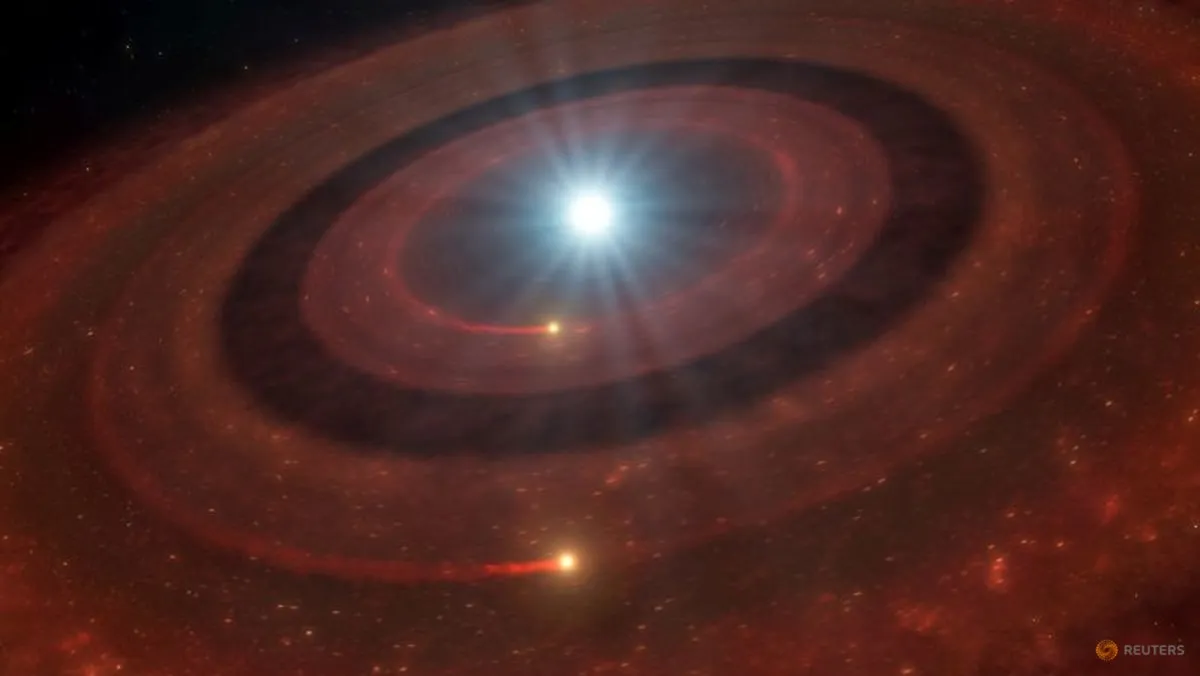
GENEVA – The global scientific community was astonished by a significant announcement in early 2026: astronomers successfully identified a white dwarf star encircled not by one, but two rings of planetary debris. This rare discovery, published after a series of meticulous observations, provides fundamental insights into the final processes of stellar life and the reformation of planetary systems.
The research, involving an international consortium of scientists from leading observatories, confirmed the existence of complex structures around the remnants of a once-mighty star. The presence of two such rings is a rarely observed phenomenon, challenging several existing theories about how planetary systems evolve after their parent star dies.
White dwarf stars are dense cores left after low to medium-mass stars, like our Sun, exhaust their nuclear fuel and shed their outer layers. They are among the most common objects in the universe, yet few are known to be surrounded by neatly structured debris rings.
This is a pivotal moment for astronomy, stated Professor Elena Petrova, head of the research team from the University of Cambridge, during a virtual press conference. We have long predicted the possibility of planetary debris surviving or reforming around white dwarfs, but to observe two distinct and stable rings is truly extraordinary. It is like finding an ancient artifact that retells history.
This identification was made using a combination of data from the Hubble Space Telescope and the Gemini Observatory, along with advanced spectral analysis capable of detecting the chemical composition of the material in the rings. The observed spectrum showed heavy elements consistent with the remnants of disintegrated planets, such as iron, magnesium, and silicon.
The discovery has sparked intense discussions among astrophysicists about the mechanisms behind this dual ring formation. One growing hypothesis is that the rings might originate from one or more planets shattered by the white dwarfs gravitational forces after the parent star expanded into a red giant and then contracted. Another hypothesis points to collisions of celestial bodies around the white dwarf.
The formation process of these rings is believed to have occurred over millions of years, with disintegrated planetary material gradually accumulating into discrete structures in specific orbits. The uniqueness of this finding lies in the stability and differentiation of the two rings, indicating complex dynamic processes that are not yet fully understood.
This finding is not just a new entry in the catalog of celestial objects, but a natural laboratory for studying the ultimate fate of our own solar system. Our Sun will also become a white dwarf in about five billion years, and its surrounding planets will likely face a similar destiny.
Astronomers hope to continue their study of this white dwarf system, aiming to gather more data through further observations. Projections for the James Webb Space Telescope are also expected to provide more detailed insights into the composition and dynamics of these rings.
Editorial Insight:
The discovery of a white dwarf with two planetary debris rings is compelling evidence of the universe's boundless dynamism. More than just an astronomical finding, it is a window into the future of our own solar system and a reminder of the cycles of life and death that govern stars and planets. The implications of this research for our understanding of exoplanetary habitability and the potential for life adapting to extreme conditions warrant further scrutiny, pushing the boundaries of astrophysics and astrobiology.