 Demian Sahputra

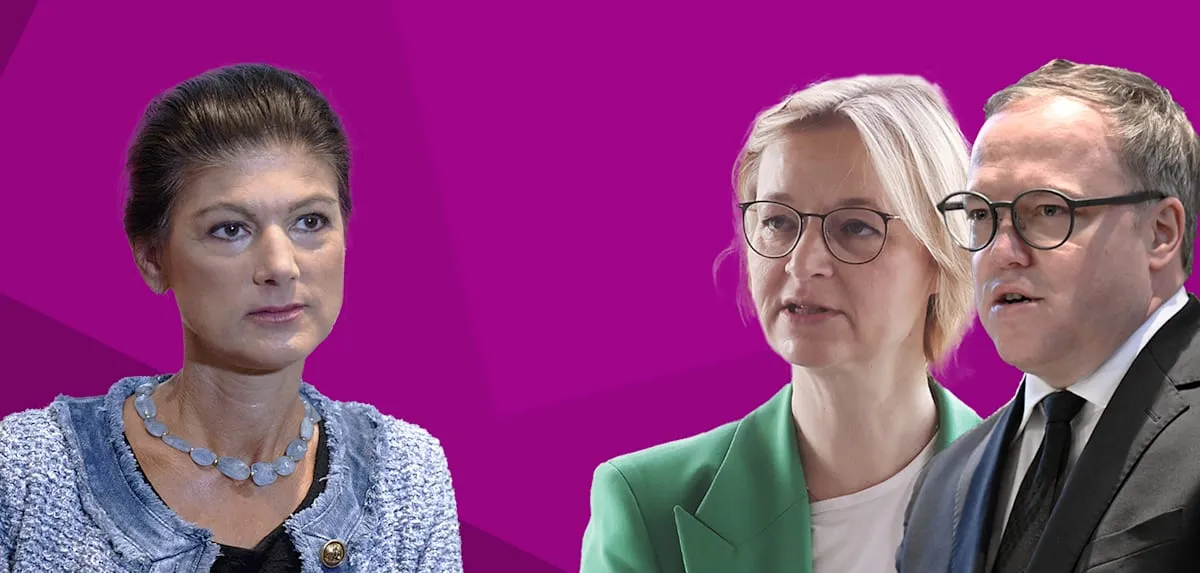
BERLIN – The political arena in Berlin is ablaze ahead of the crucial general election. During the final televised debate, broadcast on RBB-Wahlarena, a prominent politician named Krach leveled a startling accusation against Die Linke (The Left party), equating them with the conservative figure Friedrich Merz. This sharp statement was not merely ordinary rhetoric, but a strategic blow designed to shake up the electoral landscape and spark an intense debate over political identity in the German capital.
The debate, attended by leading candidates from various parties, generally did not feature significant exchanges of new positions. Participants tended to stick to their existing arguments and platforms, indicating that most votes had either consolidated or politicians were unwilling to take risks with new breakthroughs at the last minute. This very fact made Krach's accusation stand out as a pivotal moment in the discussion.
Krach, without hesitation, accused Die Linke, a traditionally left-wing party, of showing striking similarities to the political style or substance of Friedrich Merz, the charismatic leader of the Christian Democratic Union (CDU), known for his conservative and pragmatic approach. This statement implicitly challenged Die Linke's claims of ideological purity and suggested a significant shift or compromise.
You are the Friedrich Merz of the Berlin election campaign, Krach declared, sending ripples of surprise among panelists and viewers. This analogy, coming from an influential figure in Berlin politics, directly questioned Die Linke's consistency with their left-wing principles, or at the very least, how they are perceived by political opponents.
The comparison to Merz can be interpreted as a critique of perceived excessive pragmatism, a willingness to compromise on core issues, or even the adoption of more centrist political tactics to win votes. For Die Linke, which has always struggled against an image of marginalization, this accusation potentially damages their traditional support base, which highly values ideology.
The moment also highlighted the phenomenon of a particularly courted election where one party seems to be the primary target for persuasion or attack by other contestants. In this context, Die Linke, with its loyal but not dominant voter base, might be seen as the kingmaker in the city's parliamentary balance of power.
Political observers immediately interpreted Krach's accusation as a last-ditch effort to fragment Die Linke's voter support or to sway disillusioned left-wing voters to other parties. This is a classic maneuver in electoral politics to create an unfavorable narrative for opponents in the final stretch.
The palpable tension at the RBB-Wahlarena underscored the critical nature of this election for Berlin's political future. The struggle of ideologies and the scramble for power are not only occurring among major parties but also in the attempt to redefine the political identity of each opponent.
The quote also emphasizes Friedrich Merz's unique position in German politics, where his name is often used as a marker for a certain ideological spectrum. Although not directly involved in the Berlin campaign, the shadow of his influence is strongly felt, setting a benchmark for political debate.
This debate is not only important for Berlin but also provides insight into the broader political dynamics in Germany. With the election rapidly approaching, the outcome of this campaign and debate will be highly influential in determining policy directions and government coalitions at the city level.
Ultimately, Krach's statement forces Die Linke to unequivocally respond to the accusation and clarify their position to the public. Whether this accusation will succeed in eroding their electability or instead strengthen their attacked supporter base remains to be seen in the upcoming election results.
Editorial Insight: Krach's accusation equating Die Linke with Friedrich Merz in the Berlin general election debate is not merely a rhetorical flourish but a clever political strategy to redefine Die Linke's position in the eyes of voters. It highlights the pressure faced by left-wing parties to remain relevant and avoid being overly rigid in their ideology amidst an increasingly pragmatic political landscape. The implications could be crucial: it might erode support from Die Linke's traditional voters who feel their principles are being compromised, or conversely, strengthen their image as a party capable of adaptation and negotiation, albeit with the risk of losing their core identity. This event also indicates that the race for seats in the Berlin Parliament is extremely tight, and every political maneuver leading up to election day is carefully calculated to influence votes.