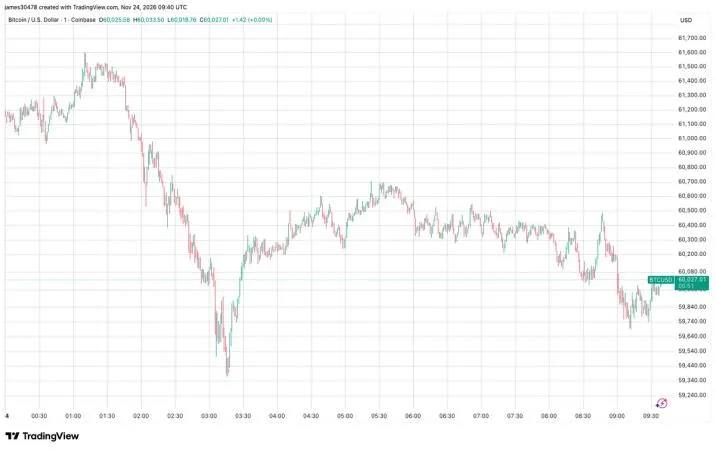
JAKARTA – The global digital asset market was once again hit by severe turbulence in 2026. Bitcoin, the largest cryptocurrency by market capitalization, drastically fell, breaching the psychological level of $60,000. This significant decline occurred as the market euphoria, previously fueled by speculation surrounding tech luminary Jensen Huang's return to Nvidia, faded, and sentiment in the tech stock sector deteriorated.
This event marks the end of a brief rally that brought optimism, but now leaves investors in uncertainty. Analysis suggests that this fall does not stand alone, but rather reflects broader pressures in the financial markets.
Nasdaq 100 futures, an index closely watched by tech investors, recorded a decline of approximately 1% after surging earlier in the week. A strong correlation often exists between tech stock movements and crypto assets, making the Nasdaq's decline a warning signal for the digital market.
Concurrently, the US Dollar Index (DXY) continued to strengthen, holding above the 104 level. This position represents its highest point since March 2025, indicating the US dollar's dominance amidst global economic uncertainty. A strengthening dollar historically tends to suppress the prices of risk assets, including Bitcoin and other cryptocurrencies, as investors shift to safer havens.
Uncertainty regarding monetary policy direction and global inflation also contributed to the prevailing volatility. Investors tend to withdraw capital from high-risk assets when the global economic outlook appears bleak or fundamental shifts occur.
Nevertheless, some parties argue that this correction is a natural part of the notoriously volatile crypto market cycle. Every asset has its ebb and flow. It is important for investors not to panic and to look at the long-term picture, stated an independent crypto market analyst who preferred anonymity.
Market observers highlight the role of fragile sentiment. Hopes for a positive impact from figures like Jensen Huang at Nvidia, a leading semiconductor company, often have ripple effects across the entire technology market and even crypto. However, when these expectations are not met or fade, a correction becomes inevitable.
The fading 'Jensen Huang effect' on Nvidia can be seen as a key catalyst for weakening investor sentiment. Issues related to tech leaders and corporate giants frequently influence market movements significantly. Readers can further review similar dynamics in our article on Trump Claims Nvidia Success, Posts Jensen Huang Meme Sparks Controversy.
This incident once again reminds investors of the inherent risks in digital currency investments. Extreme price fluctuations necessitate a mature investment strategy and a deep understanding of the market. Discussions about the legality and regulation of digital currencies are also becoming increasingly relevant, as we previously covered in the article US Regulators Approve Crypto as Exchange Reserve: A Signal of Official Recognition? which discusses the recognition of crypto as exchange reserves.
Despite the downturn, the crypto community remains optimistic about Bitcoin's long-term potential as a revolutionary asset. However, the journey toward stability is still long and full of challenges.
Editorial Insight:
Bitcoin's drop below $60,000 is more than just a technical correction; it is a reflection of the complex interconnectedness of modern markets. Investor sentiment, movements in traditional stock indices like Nasdaq, and the strength of fiat currencies such as the US dollar, all interact to form a volatile investment landscape. The 'Jensen Huang effect' or any other central figure's influence, however strong, ultimately cannot sustain the market if macroeconomic fundamentals are not supportive. This underscores that the digital age demands investors not only understand technology but also the global economic dynamics comprehensively, especially in a year like 2026, which is fraught with uncertainty.