 Stefani Rindus
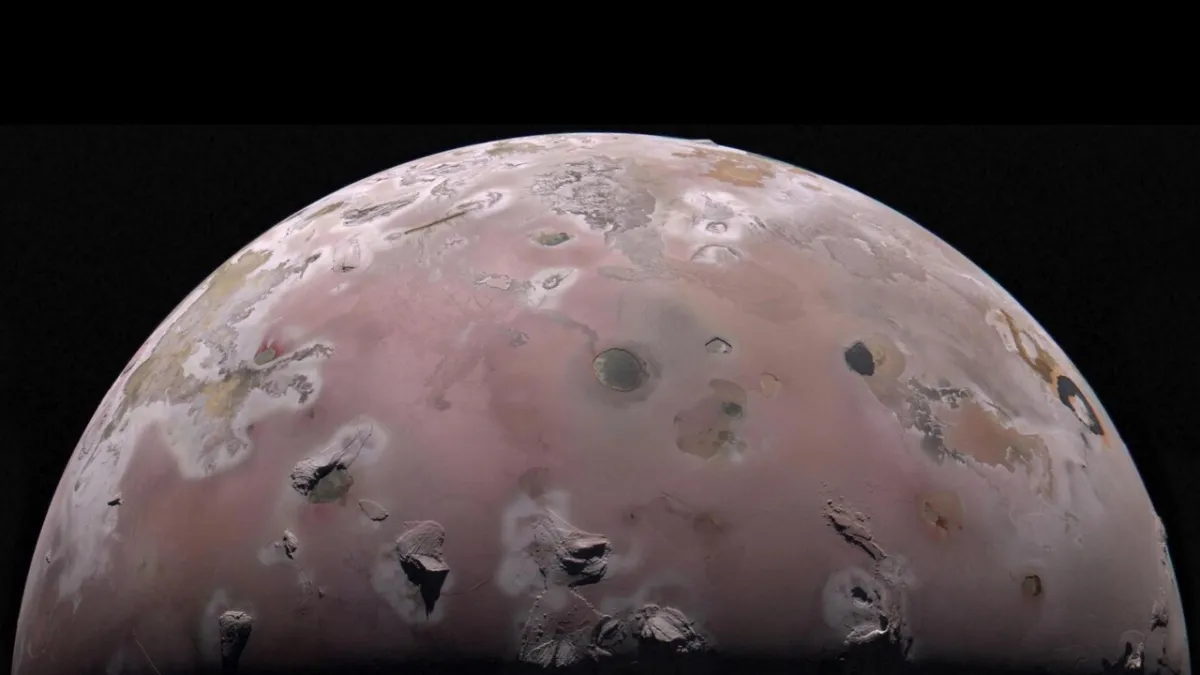
Earth – NASA's Juno spacecraft has marked a new milestone in space exploration this year, 2026, by unveiling 'the most faithful portrait' of Io, Jupiter's innermost moon. The ongoing mission successfully detected significant heat sources deep beneath its surface, a crucial finding that uncovers the extreme geological activity of the moon known as the most volcanic object in our entire solar system.
This revolutionary discovery, announced by the Juno science team, came after careful analysis of data collected during several close approaches of the spacecraft to Io. The data unequivocally showed thermal anomalies consistent with the presence of liquid or semi-liquid material at depth.
Io, with over 400 active volcanoes, has long been a subject of fascination for astrophysicists. However, the internal mechanisms driving its massive volcanism remain a fiercely debated topic. Juno's detection of subsurface heat provides concrete evidence supporting the theory that Jupiter's tidal gravitational forces play a central role.
Juno, originally designed to study Jupiter's atmosphere and magnetosphere, has demonstrated remarkable flexibility by extending its mission scope to the gas giant's moons. The Microwave Radiometer (MWR) instrument on Juno played a key role in penetrating layers of ice and rock to 'see' beneath Io's surface.
Scientists speculate that this internal heat originates from the immense friction generated by the powerful gravitational pull of Jupiter and its other Galilean moons, Europa and Ganymede. These tidal forces continuously squeeze and stretch Io, producing frictional heat that far surpasses Earth's radiogenic heat.
This finding is not just a confirmation, but a major leap in our understanding of how extreme moons like Io can sustain such intense geological activity for billions of years, stated Dr. Valeria Schmidt, a lead researcher from the Juno team, during a virtual press conference from NASA's Jet Propulsion Laboratory (JPL). This quote underscores the importance of the new data.
The implications of this discovery are vast. It not only deepens the understanding of Io's own evolution but also provides valuable insights into thermal processes on other celestial bodies in the universe, including exoplanets that may harbor similar active moons.
With more detailed data on heat distribution, scientists can now construct more accurate models of Io's internal structure, including crust thickness, mantle composition, and the size of any potential magma core. This information is essential for unraveling the thermal evolution and geodynamics of this moon.
The Juno mission is scheduled to continue its observations of Jupiter and its moons, with the hope of collecting more data that will enrich our understanding. Each close flyby of Io carries the potential for new discoveries that will continue to change our perspective on worlds beyond Earth.
Juno's discovery of subsurface heat solidifies Io's role as a natural laboratory for the study of extreme volcanism and gravitational interactions in the solar system. It is a significant step in our quest to understand the mysteries of the universe.
Editorial Insight: The detection of Io's subsurface heat by Juno represents more than just scientific data; it is a brilliant validation of our space exploration capabilities. This finding will ignite a new wave of research, redefine lunar geodynamic models, and potentially pave the way for future exploration missions targeting the interiors of geologically active celestial bodies, shifting the paradigm about the dynamics of moons out there.