 Edward DP Situmorang
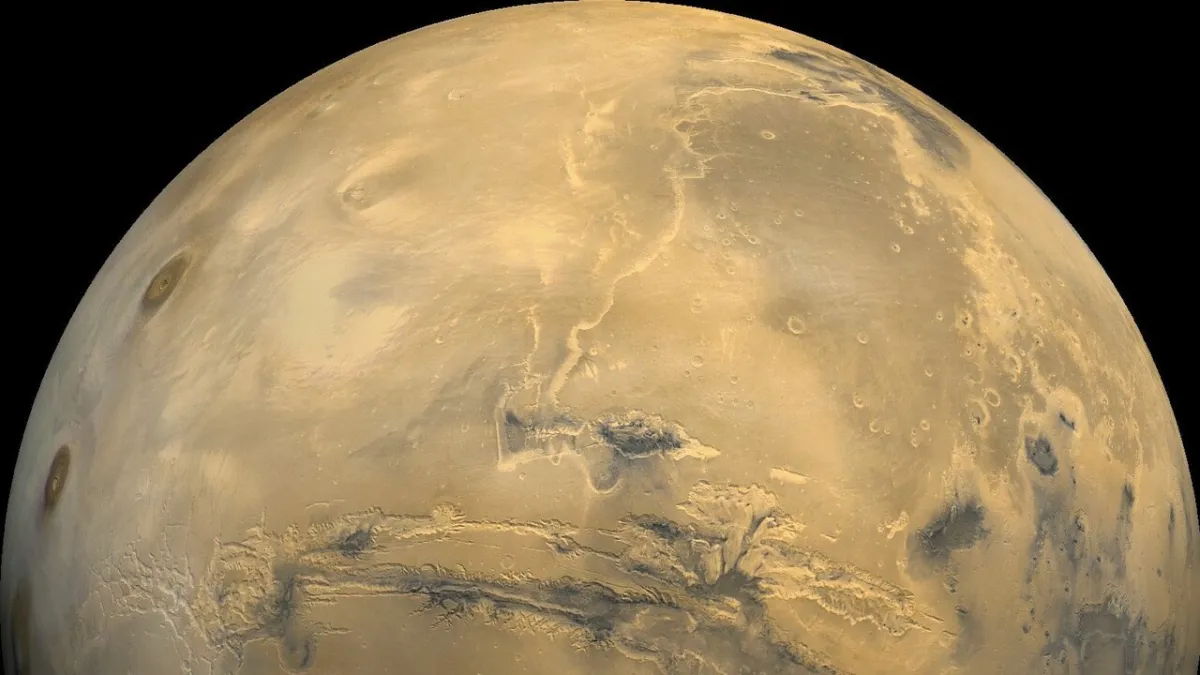
Pasadena – A revolutionary study announced by a team of scientists from NASA's Jet Propulsion Laboratory (JPL) recently revealed that seismic activity, or 'Marsquakes,' played a crucial role in the formation and evolution of Valles Marineris, the largest canyon system in the Solar System. This discovery stems from an in-depth analysis of data collected by the InSight lander before its mission concluded in 2022, providing new insights into the Red Planet's geological dynamics that challenge previous assumptions.
The InSight lander, which operated on Mars from 2018 until late 2022, was specifically designed to study Mars' interior using sensitive seismometers. Throughout its operational period, InSight successfully recorded hundreds of 'Marsquakes,' a phenomenon previously not well understood. This seismic data became the primary foundation for the latest research.
Valles Marineris, a breathtaking geological feature spanning approximately 4,000 kilometers in length, up to 200 kilometers in width, and 7 kilometers in depth, has long been an object of study. Its colossal scale far surpasses Earth's Grand Canyon, making it one of the most dominant geological features on the Martian surface.
Previously, the prevailing theory suggested that Valles Marineris formed due to global tectonic stresses causing the Martian crust to stretch and crack. However, InSight's data now offers a more complex narrative, indicating that the planet's internal vibrations significantly contributed.
Scientists explain that Marsquakes are not merely passive tremors. Seismic waves propagating through the planet's interior layers can trigger rock movements and faults, gradually eroding and shaping surface structures, including giant canyons like Valles Marineris.
Careful analysis of seismic wave patterns recorded by InSight revealed a correlation between seismic activity and geological formations around the Valles Marineris area. The intricate crack patterns and fault characteristics indicate continuous stress and strain.
These findings imply that Mars might have been more geologically active in the past, with more intense seismic activity shaping its landscape. This opens up new possibilities for understanding how Mars' water and atmosphere evolved, as well as the potential for ancient microbial life-supporting environments.
The understanding of Valles Marineris is not just about topography, but also about the entire geological history of Mars, prompting revisions of older models concerning the planet's evolution.
This discovery not only enriches fundamental knowledge about Mars but also provides valuable insights for future human exploration missions. Understanding geological stability and potential seismic hazards will be crucial in planning Martian bases and interplanetary travel.
The study also suggests the possibility of hydrothermal activity deep within Valles Marineris that could be linked to Marsquakes. Such environments, if present, are often potential sites for microbial life sustenance, adding a new dimension to the search for extraterrestrial life.
Editorial Insight: The discovery that Marsquakes play a significant role in the formation of Valles Marineris represents a major leap in our understanding of planetary dynamics. It underscores the importance of long-term missions like InSight, whose data continues to be analyzed years after its operational conclusion, revealing a geological complexity of Mars far beyond initial estimates. Its implications are broad, from revising planetary evolution models to planning human exploration, affirming that Mars still holds many secrets waiting to be unveiled.