 Stefani Rindus
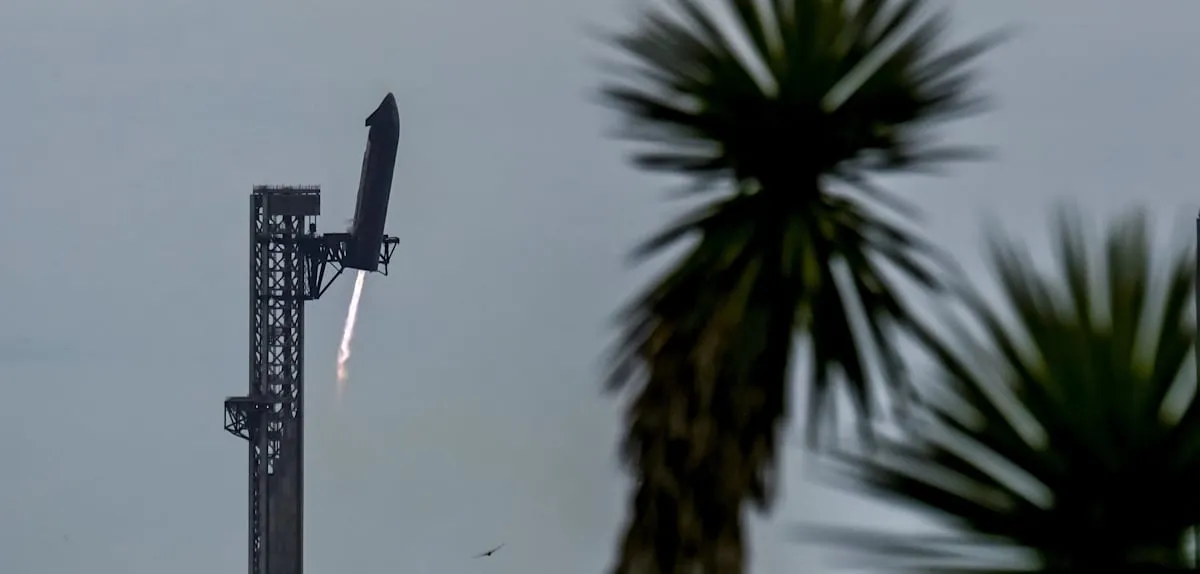
TEXAS – A new chapter in space exploration unfolds as SpaceX's Starship rocket, under the visionary guidance of Elon Musk, successfully achieved an autonomous vertical landing by being caught by its launch tower in Texas. This achievement, recorded during its 15th flight, is not merely a technical triumph but a monumental leap, heralding a new era in interstellar exploration and the potential development of a multi-planetary fleet.
The crucial moment occurred at SpaceX's Starbase test facility in Boca Chica, Texas. After a series of high-precision maneuvers, the upper stage of the Starship rocket was accurately gripped by the mechanical arms of the launch tower, a scene previously confined to the imagination of space engineers.
This event solidifies SpaceX's dominance in reusable rocket technology innovation. Since its inception, Starship has been designed as a fully reusable vehicle, a concept essential for lowering the cost of space travel and accelerating the colonization of Mars.
Elon Musk, founder and CEO of SpaceX, has repeatedly stated that Starship is the key to humanity's multi-planetary future. His ambitious vision of establishing self-sustaining colonies on Mars now feels significantly closer with the realization of such technical successes.
Catching a rocket directly with a tower is a far more complex technique than vertical landings using landing legs. It demands extraordinary accuracy and control from the rocket's navigation and propulsion systems, along with perfect coordination with ground infrastructure.
This is clear evidence that human engineering can overcome even the most extreme limitations, remarked an independent space analyst following SpaceX's developments. The ability to directly catch a rocket eliminates the weight and complexity of landing legs, paving the way for unprecedented operational efficiency.
Starship's 15th flight is the culmination of a long process of iteration and learning. Several previous attempts faced challenges, even failures, but each incident provided valuable data that spurred the engineering team behind the project to continuously innovate and refine the design.
The development of the Starship rocket is one of the most ambitious projects in aerospace history. Its primary goal is not only to transport humans to the Moon and Mars but also to provide an economical and sustainable means of transport for various missions, from satellite launches to deeper solar system exploration.
This success also has broad implications for the space industry as a whole. Other nations and private entities will now be motivated to develop similar technologies, fostering an innovation race that could revolutionize access to space.
This achievement adds to the long list of innovations presented by entities associated with Elon Musk. Previously, his other technology companies have also made significant strides, such as the launch of Tesla's Cybercab service, which sparked controversy in the autonomous transportation market.
With this successful landing, Starship is one step closer to becoming the most powerful and advanced space launch vehicle ever built. Its role in establishing permanent bases on the Moon through NASA's Artemis program, as well as realizing journeys to Mars, is now increasingly realistic.
Editorial Insight: The successful capture of the Starship rocket marks a significant turning point in humanity's quest to conquer space. This is not merely a technological demonstration; it is the foundation for a much more efficient and sustainable space travel ecosystem. Its long-term impact will be felt in the democratization of access to outer space, opening opportunities for exploration and resource utilization previously confined to science fiction. This innovation will accelerate the realization of Elon Musk's and humanity's dream of becoming a multi-planetary species.