 Dodi Irawan
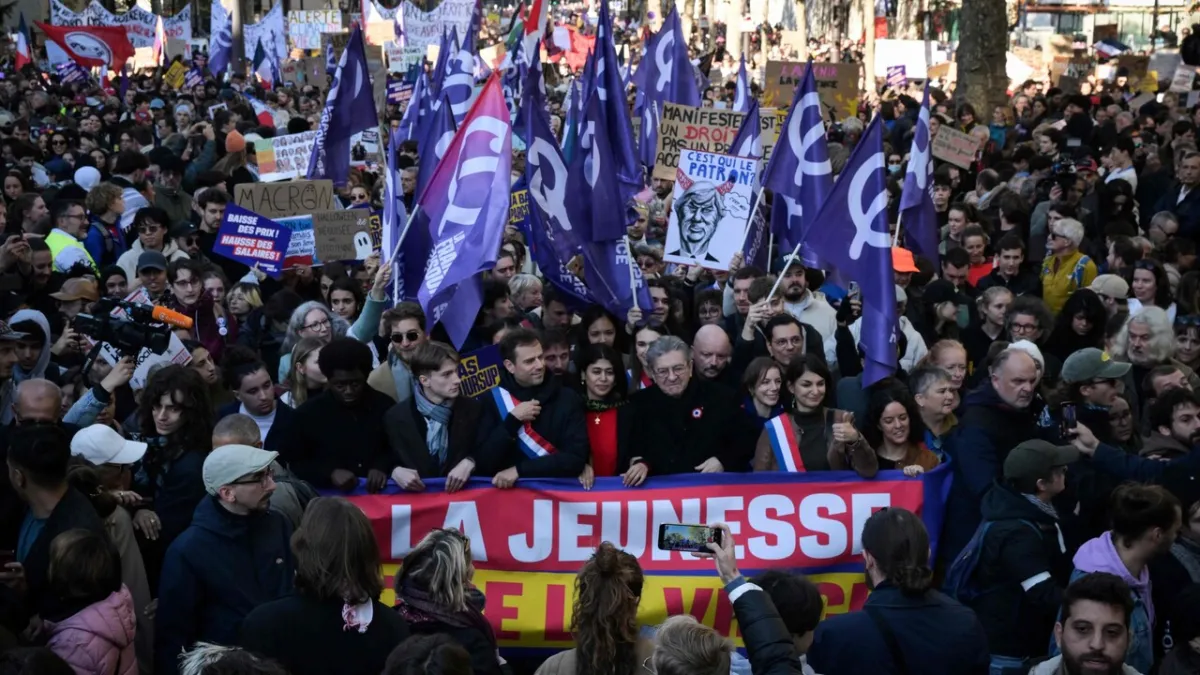
PARIS – Tens of thousands of Parisian citizens marched on Saturday (October 26, 2026), in a massive demonstration expected to draw 100,000 participants. The protest unfolded in the eastern periphery of the French capital, following a controversial decision by the Council of State that banned demonstrators from gathering at the iconic Bastille. Serious concerns have emerged regarding the potential infiltration of 'ultraviolent' elements capable of instigating disorder.
The current demonstration centers on demands not yet specifically revealed to the public, but often reflect the social and political unrest plaguing France. The initially planned route, which was intended to conclude at Place de la Bastille, a historic site for revolution and protest in France, had to be diverted.
This route diversion resulted from a ruling by the Council of State, France's highest administrative court. The decision overturned a prior ruling by the Tribunal Administratif Regional (TAR) which had granted permission for demonstrators to use the Bastille as their endpoint.
The Council of State's decision, which contradicted the TAR's initial judgment, indicates deep concern from the government and security authorities regarding the potential for an escalation of violence. Bastille's strategic and historical location often serves as a magnet for groups wishing to voice protests with greater impact, but also attracts provocative elements.
Paris Police Chief, Christophe Gauthier, stated in a previous press conference that intelligence identified extremist groups planning to hijack this peaceful demonstration. 'We have credible information about individuals or groups intending to commit violence and destruction,' he remarked.
The threat from so-called 'ultraviolent' groups is not new to Paris. The history of demonstrations in the city is frequently marked by clashes between radical protesters and security forces, often leading to vandalism and injuries. This serves as a primary reason behind the decision to alter the route and heighten security measures.
Despite the route alteration, the spirit of the demonstrators remained undeterred. They continued to voice their aspirations along the established alternative route. Security forces have been fully deployed at various strategic points, striving to maintain order and ensure the protest proceeds peacefully.
Social observers highlight the dynamic interplay between the right to free expression and the need to maintain public safety. 'This is a classic dilemma for any democratic nation. How to balance freedom of expression with security risks,' commented Dr. Sylvie Dubois, a political sociologist from Sorbonne University.
Dubois added that the Council of State's decision, while limiting certain rights, might be seen as a preemptive measure to prevent a worst-case scenario. 'However, it could also fuel sentiment that the government is attempting to silence the people's voice, which could actually worsen the situation,' she continued.
Protests in France, particularly in Paris, have a long history of shaping the nation's social and political narrative. From revolutions to the yellow vest movement, the streets of Paris have always been a stage for collective expression. The fear of violence always casts a shadow over mass gatherings.
The French government itself has repeatedly affirmed its commitment to protecting democratic rights. However, it also emphasizes the importance of safeguarding citizen safety and property. This situation in Paris is a tangible example of the ongoing tension between these two crucial principles.
The Council of State's final decision to prohibit demonstrators from Bastille signifies that public safety priority was placed above the freedom to assemble at a specific, high-potential conflict location. This sets an important precedent for handling future demonstrations.
The protest unfolding in the city's eastern periphery is hoped to mitigate the potential for major clashes, though it still requires vigilant oversight. The presence of approximately 100,000 individuals underscores the strength of public aspirations that need to be heard.
Similar waves of protests, highlighting public frustration with systems or policies, are also observed in other countries. For instance, in Germany, 'Frustrated Gen Z' have also reportedly protested against systemic inequality, illustrating a global pattern of social unrest. (See also: Germany Haunted by Frustrated Gen Z: Systemic Inequality Triggers Wave of Protests?).
Editorial Insight:
The decision by the French Council of State in this instance reflects the pragmatic efforts of authorities to manage the high security risks inherent in large-scale demonstrations, especially in a metropolitan city like Paris. While it curtails the symbolism of the Bastille location, its primary objective is to mitigate the potential for violence often infiltrated by extremist groups. The challenge lies in maintaining public perception that these restrictions are not an attempt to silence democratic rights, but rather a preventive measure for collective safety. The effectiveness of this step will be tested by how the mass action unfolds and the long-term response from civil society.