 Chandra Wijayanto
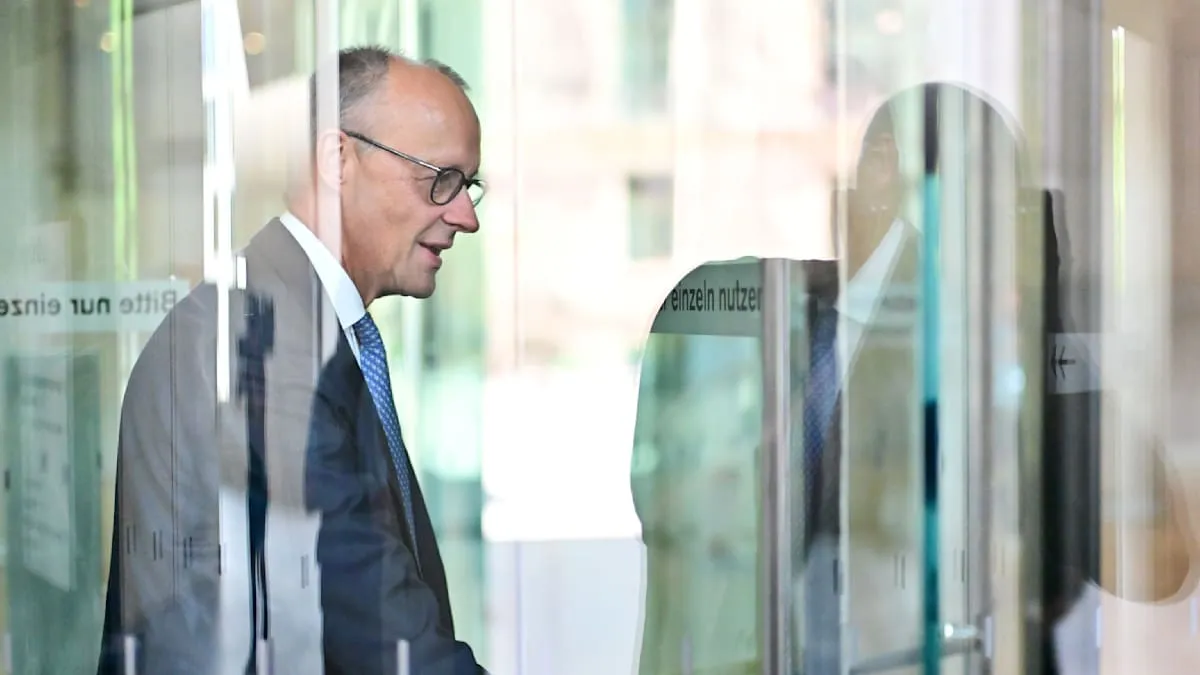
BERLIN — German Chancellor Friedrich Merz currently faces the most challenging period of his political career ahead of the 2026 Federal Elections. Analysis from leading political scientist Oliver W. Lembcke indicates that Merz's position hangs by a thread amidst plummeting party approval ratings and minimal internal support, sparking speculation about his potential to become a "dead man walking" on Germany's political stage. This precarious situation threatens the stability of the governing coalition and the future of national policies.
The pressure on Chancellor Merz has intensified following the publication of recent opinion polls showing a significant decline in public support for both himself and the Christian Democratic Union (CDU) party. These figures serve as a serious red flag, particularly with a series of regional elections approaching, which could serve as crucial barometers for the 2026 Federal Elections.
Oliver W. Lembcke, known for his sharp political analyses, explained that the situation is exacerbated by a lack of consolidation within the CDU itself. "This condition repeatedly and eruptively drives the Chancellor discussion," Lembcke stated. "When approval ratings weaken and there is no solid backing, one might soon become a ‘dead man walking’." This assessment underscores the fragile foundations of Merz's power.
The phrase "dead man walking" uttered by Lembcke refers to the condition of a leader who formally still holds office, but whose power and influence have been completely eroded, merely awaiting their replacement. This paints a grim picture for a Chancellor who has only been in office for a year and aims to guide Germany through global economic and geopolitical turmoil.
Merz's electoral weakness is not merely a reflection of public dissatisfaction with his government's policies, but can also be interpreted as an indicator of broader political fragmentation in Germany. The emergence of alternative political forces, as well as intense debates on crucial issues such as energy, immigration, and defense, contribute to the political uncertainty.
One of the driving factors behind the decline in popularity is the government's response to the ongoing energy crisis, as well as environmental reforms that have drawn criticism from various sectors of society. These policies, intended to secure Germany's future, have instead created polarization and added economic burdens for households and industries.
Lembcke added that the failure to secure strong support from his own party base constitutes a fatal flaw. Without internal loyalty and solidarity, every political maneuver by Chancellor Merz will invariably be questioned, limiting his room for bold and effective strategic decision-making.
This situation recalls political dynamics often observed when a dominant party begins to lose its grip on power. German political history records several similar cases where strong leaders eventually had to yield to pressure from within their party and public opinion.
Facing potential defeat in the upcoming elections, the CDU is now confronted with a difficult choice: whether to retain Chancellor Merz with all his risks, or to begin considering alternative leadership to revitalize the party. Intense internal discussions are predicted to be a central agenda for the party in the coming months.
Chancellor Merz's future depends not only on his personal ability to reverse negative trends but also on the party's overall strategy in facing the 2026 challenges. The big question is whether Merz possesses the capacity to prove himself as an irreplaceable leader or if he will fulfill Lembcke's prophecy of becoming a "dead man walking."
Discussions concerning Germany's political stability and Merz's role are not new. Various previous analyses have highlighted the vulnerability of party leadership, as reviewed in the article The Test of German Political Resilience: Merz Challenged, Party Accused of Fragility in 2026. Similar challenges continue to haunt.
The impact of this leadership crisis extends beyond internal party boundaries. Chancellor Merz's coalition partners also feel the tremors of uncertainty, potentially weakening the government's effectiveness in pursuing crucial national agendas.
Economic stability and investor confidence could also be affected if political speculation continues to run rampant. Amid global uncertainties, Germany requires strong and stable leadership to maintain its position as Europe's economic powerhouse.
The 2026 elections will be a crucial proving ground for Chancellor Merz and the CDU. This is not merely an ordinary electoral battle but a fundamental test of the party's capacity to adapt and maintain its relevance in an ever-changing political landscape.
Political observers note that if Merz does not quickly find a formula to turn the situation around, Lembcke's prediction could become a bitter reality. A leadership transformation might become an inevitability for the survival of the party and the future of German politics.