 Demian Sahputra
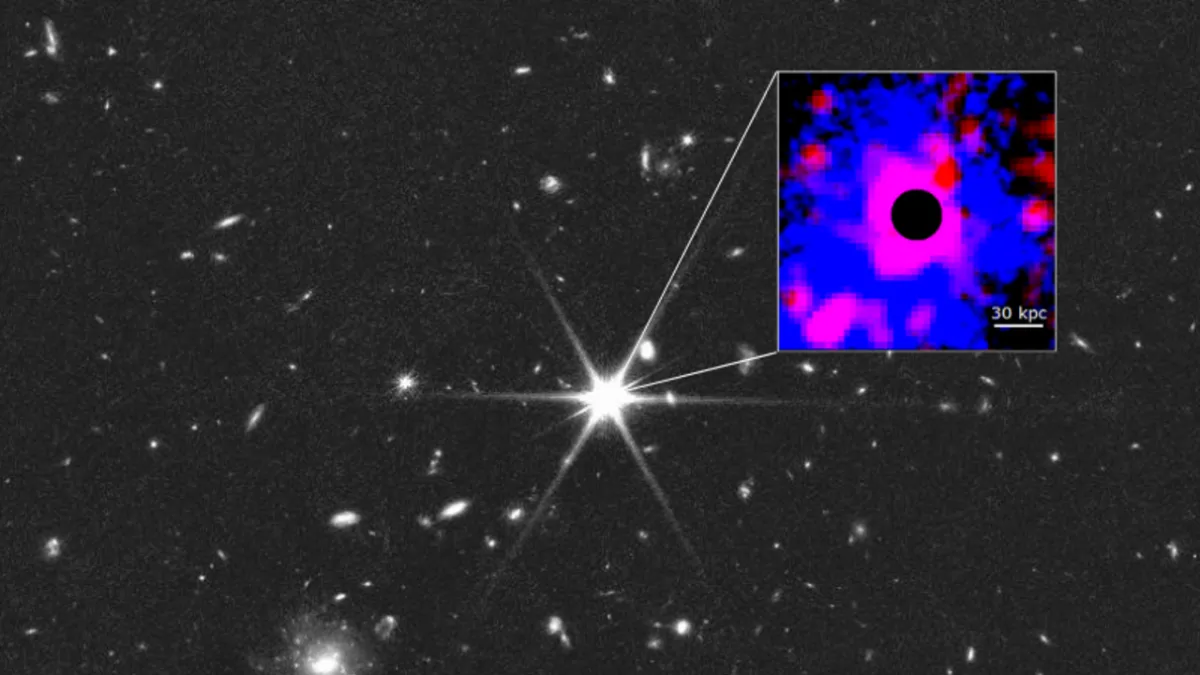
Jakarta – Global astronomers have recently been astounded by a significant discovery made by the Chandra X-ray Observatory. For the first time, the "warm breath" of an ancient galaxy cluster has been observed, a phenomenon that occurred when the universe was only about two billion years old. This observation, involving 180 hours of data, provides crucial insights into how the largest structures in the cosmos began to form and evolve in their earliest era.
This spectacular discovery, published in a leading scientific journal in early 2026, elucidates the presence of extremely hot gas enveloping the galaxy cluster. The "warm breath" phenomenon refers to gas heated to millions of degrees Celsius through intense gravitational processes as galaxies began to coalesce to form giant clusters.
The international research team, led by Dr. Anya Sharma from Cambridge University, stated that this observation is a "direct window" into the cosmic past. "Previously, we could only model how galaxy clusters formed. Now, with Chandra data, we have empirical evidence of this vital process in the young universe," said Dr. Sharma during a virtual press conference.
The Chandra X-ray Observatory, operated by NASA, once again proves its capability in capturing fine details of high-energy events in space. Over a total of 180 hours of in-depth observation, Chandra successfully detected X-ray emissions from superheated gas invisible to ordinary optical telescopes. The long duration of observation allowed scientists to distinguish very faint signals from the distant galaxy cluster.
When the universe was only two billion years old, it was in a period of rapid transformation. The first stars and galaxies began to form, and gravity slowly pulled matter together to create larger structures. Galaxy clusters are the largest aggregations of galaxies, hot gas, and dark matter, and the discovery of this "warm breath" marks the beginning of their formation.
This research is highly important for understanding the dynamics of galaxy cluster formation. The detected hot gas is a key indicator of the energy released during the merger and growth processes of clusters. It also provides clues about how dark matter, which is the dominant component of clusters, interacts with gas and galaxies.
Scientists compared this ancient cluster to closer, younger galaxy clusters. Differences in the distribution and temperature of the hot gas provide a clear evolutionary picture. Younger clusters tend to have more uneven gas distribution and may be hotter in some areas, reflecting active ongoing formation processes.
The impact of this discovery on the field of cosmology cannot be overstated. "It strengthens our understanding of the standard cosmological model and provides new constraints for computer simulations attempting to replicate the universe's evolution," added Professor Ben Carter, an astrophysicist from the Australian National University, also involved in the research.
Future work will involve further observations with Chandra and next-generation telescopes, such as the European Space Agency's (ESA) planned Athena X-ray Observatory. The goal is to discover more ancient galaxy clusters with similar "warm breaths" to confirm these findings and build a more complete picture of the early universe.
This discovery opens a new chapter in our quest to understand the origins and evolution of the universe. From microscopic structures to mysterious cosmic phenomena, each new revelation brings us closer to answering fundamental questions about our existence.
Researchers also highlighted how these findings could help solve the cooling flow paradox in galaxy clusters, a problem that has puzzled astronomers for decades. By understanding how hot gas evolved in the early stages, they can more accurately predict the behavior of gas in older clusters.
This type of research also underscores the importance of continuous investment in space research infrastructure. Telescopes like Chandra, with their long lifespan and unparalleled capabilities, continue to deliver fundamental discoveries that push the boundaries of human knowledge.