 Gabriella
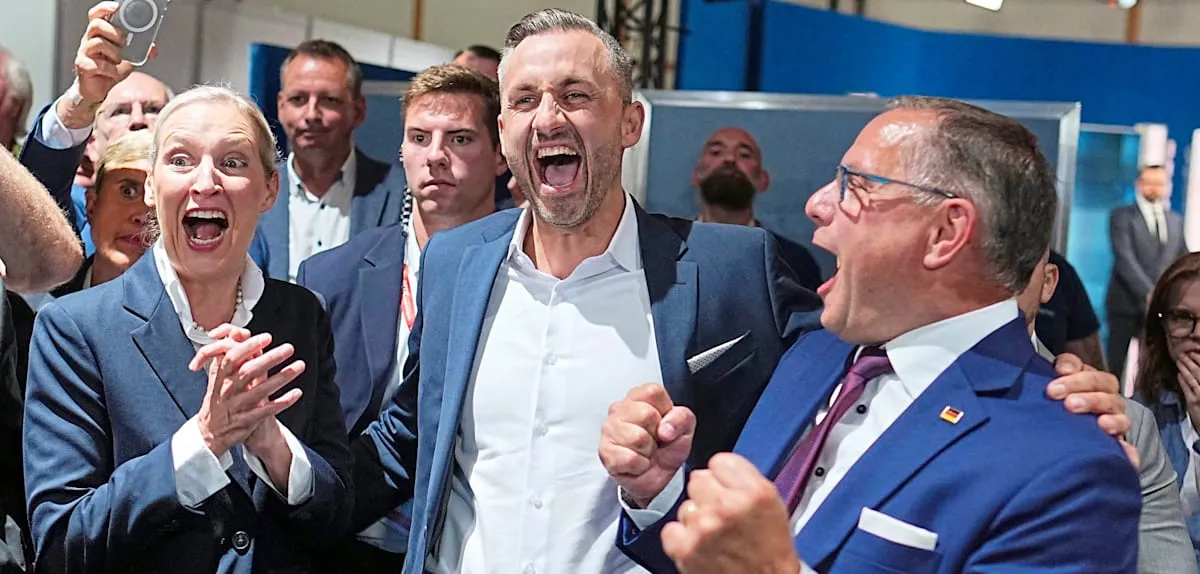
BERLIN – The Alternative for Germany (AfD) party recorded a significant surge in popularity, leading far ahead of the conservative Union bloc (CDU/CSU) in the latest INSA poll. These results fundamentally alter the projected coalition formations in the German parliament, simultaneously marking a substantial shift in political power.
The latest INSA survey reveals the detailed electability of key parties in Germany:
- Alternative for Germany (AfD): 29 percent
- Union (CDU/CSU): 20 percent
- Green Party (Die Gruenen): 14 percent
- Social Democratic Party (SPD): below 14 percent
The nine-percentage-point difference between AfD and the Union is a strong indicator of eroding support for established parties, positioning AfD as a leading political force.
Germany's political dynamics are becoming increasingly complex, with the Green Party now surpassing the Social Democratic Party (SPD). The Greens' 14 percent share leaves behind the SPD, which is one of the pillars of the current governing coalition.
This shift in electability directly impacts the possibilities for future coalition formations. Traditional configurations that have long dominated the political landscape now face serious challenges, requiring a recalculation for every political force.
The consistent rise of the AfD in recent years has become a major concern. Starting as a Euro-skeptic movement, the party evolved into a far-right force attracting voters with issues of immigration and nationalism.
Meanwhile, the decline in support for the Union, historically one of the dominant forces, indicates voter dissatisfaction with current policies and leadership. This reflects the internal and external challenges faced by the party.
The current governing coalition, led by the SPD with the Greens and FDP, also faces pressure. Although the Green Party shows growth, the challenge of forming a stable and effective government is growing amidst political fragmentation.
German political observer, Dr. Klaus Mueller, highlighted, These survey results are not just numbers, but a reflection of profound changes in German public sentiment. The political landscape we know may soon change.
Potential coalitions are now harder to predict. Options previously considered impossible, such as coalitions involving extremist parties or broader grand coalitions, are now being discussed again. Discussions about forming steadfast coalitions, as once emphasized in the European context, for example when Italian Prime Minister Meloni affirmed a coalition without opponents of Ukrainian support, become relevant. Although the context differs, the spirit of finding common vision remains crucial. Meloni Tegas: Koalisi Tanpa Penentang Dukungan Ukraina.
As elections draw nearer, political parties in Germany are compelled to formulate more adaptive strategies. The ability to appeal to voters amidst polarization and overcome internal divisions will be a key determinant of the country's political future.
Editorial Insight: The dramatic shift in Germany's political landscape, marked by the strengthening of AfD and the weakening of the Union, reflects a crisis of identity and relevance faced by mainstream parties. These survey results have the potential to trigger a period of political instability, requiring rapid adaptation from across the party spectrum. The consequences will not only be felt domestically in Germany but could also impact the dynamics of the European Union and global stability.