 Angel Doris
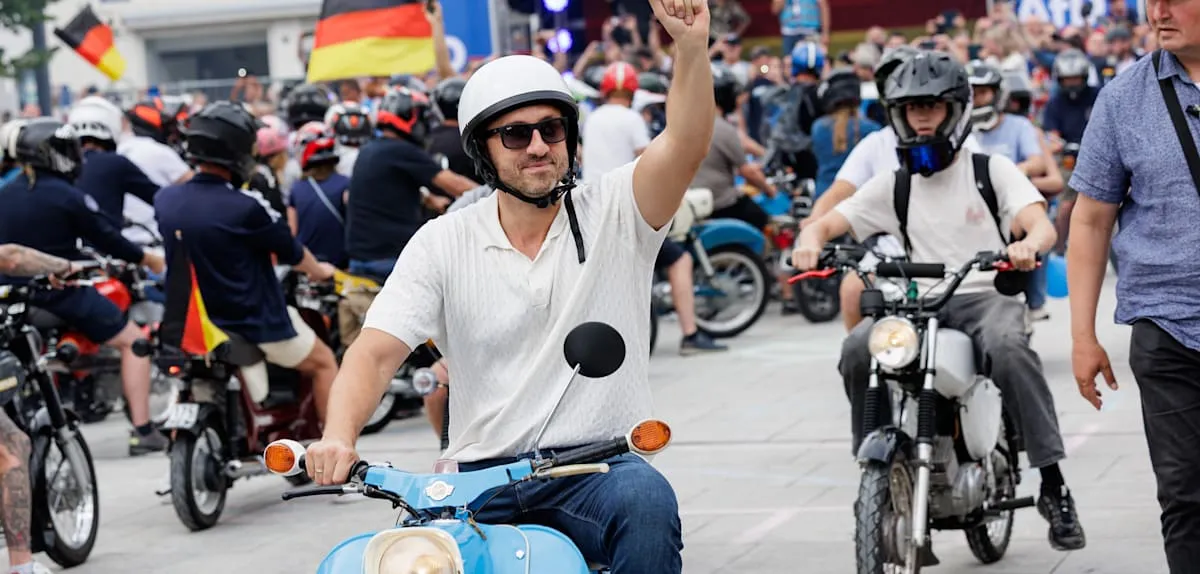
WEISSENFELS — Ulrich Siegmund, a leading candidate for the Alternative for Germany (AfD) party, has once again captured public attention ahead of the 2026 general election. He is continuing his campaign tour in the state of Sachsen-Anhalt by riding a classic Simson motorcycle, an icon from the East German era, amidst strong criticism from the heirs of the legendary brand. Siegmund's presence in Weißenfels successfully attracted approximately 1500 citizens, demonstrating the unique appeal of his strategy which blends nostalgia and political controversy.
Despite facing rejection and legal reprimands over the use of the Simson symbol, which is considered to tarnish its historical value, Siegmund remains steadfast. He has chosen an unconventional campaign path, carrying his party's ideology on a motorcycle rich with historical meaning for a large segment of East German society. This approach effectively creates broad discussion, not only about his political program but also about the use of cultural heritage in the electoral arena.
Siegmund's Simson campaign tour has become a national media highlight. In Weißenfels, a fascinating moment occurred when he encountered a ZDF reporter riding a modern racing bicycle. This contrasting meeting symbolically depicts the clash between tradition and modernity, between nostalgia for the past and the narrative of the future that contemporary politicians seek to voice.
The heirs of the Simson brand had previously expressed objections to the use of their motorcycles for political purposes, especially by a party like the AfD, which is often associated with certain nationalist sentiments. They emphasize that Simson is a symbol of unity and freedom, far removed from political polarization. However, Siegmund seems to see this as an opportunity to attract a voter base longing for the identity and stability of the past.
This campaign strategy by Siegmund is not without risks. He potentially alienates some voters who are sensitive to the partisan use of historical symbols. However, on the other hand, he has also successfully mobilized support from segments of society who feel marginalized and seek representation for values they believe have been lost.
The enthusiasm seen in Weißenfels, with 1500 people present, underscores the effectiveness of this personal and visual approach. The public, especially the generation that grew up with Simson, feels an emotional connection to Siegmund's presence. This demonstrates that in a fast-paced digital age, physical touch and symbolism still play a vital role in political campaigns.
Political analysis indicates that the AfD often uses identity issues and cultural heritage to strengthen its position in former East German territories. Siegmund's use of Simson is a clear example of how a party attempts to break through conventional political communication boundaries and directly touch collective emotions. This is similar to how other political parties in Europe utilize their national symbols.
The controversy surrounding the Simson campaign also triggers a broader discussion about the limits of freedom of expression in politics and how cultural heritage should be treated. Can a historical object be used as a political campaign tool without the consent of its descendants or copyright holders? This question becomes relevant amid Germany's increasingly complex political dynamics.
Amidst this heated debate, Siegmund remains firm in his convictions. For him, Simson is not just a motorcycle, but a representation of the spirit of resilience and identity once possessed by East Germany. He argues that his goal is to bring that spirit back into modern political discourse, regardless of the existing criticism.
The continuation of this unique campaign also attracts the attention of academics and media observers. They highlight how this tactic successfully breaks the deadlock of political narratives that are often too formal and rigid. With Simson, Siegmund creates a memorable visual, making it viral on social media platforms and news channels.
Local political observers in Sachsen-Anhalt believe that this strategy, despite its risks, has the potential to boost Siegmund's electability, especially in strongholds of nostalgia for the past. Former East German regions often serve as significant AfD support bases.
It is important to note that the 2026 elections in Germany will be crucial in determining important policy directions, both at regional and federal levels. Parties are working hard to find innovative ways to reach voters, and Siegmund's Simson tactic is one manifestation of these efforts.
How do other parties respond to Siegmund's maneuver? Most choose not to directly comment on the Simson, but rather focus on the substance of their programs. However, there is an implied admiration for Siegmund's ability to create a massive wave of public attention.
Siegmund's encounter with the ZDF reporter in Weißenfels also becomes an interesting anecdote showing how contemporary politics often becomes a spectacle. The reporter, with his racing bicycle, indirectly becomes part of a larger narrative about how politicians and media interact in the modern era.
Ultimately, the results of the 2026 election will be the most accurate indicator of how effective bold and controversial campaign strategies, such as Siegmund's, are in influencing voter sentiment. Is Simson's nostalgia strong enough to secure a victory for the AfD in Sachsen-Anhalt?
This Simson campaign phenomenon also broadly reflects the ongoing debate in Germany about national identity and how society views the legacy of the past, particularly the legacy of the German Democratic Republic (DDR). Simson, as an iconic DDR product, has now become a symbolic battleground.
Criticism from Simson's heirs is not just a legal issue but also an ethical one. They argue that the exploitation of symbols without permission and for specific political purposes can damage the brand image they have maintained. This raises questions about ownership rights and historical interpretation.
Beyond the political aspect, this campaign also sheds light on the active community of Simson enthusiasts in Germany. They are the guardians of nostalgia and DDR automotive history, and unknowingly, they become part of a larger political narrative.
Political controversies in Germany are not new. Similar dynamics can be seen in other issues, such as the debate surrounding the role of Russian sponsors in football, which was once touched upon by Vannacci defending Pirlo. This shows how the lines between sports, culture, and politics are often blurred in Europe.
Therefore, Ulrich Siegmund's campaign with Simson is more than just a political tour. It is a statement, a provocative strategy that challenges conventions, and a case study of how politicians strive to win the hearts and minds of voters amidst the bustling media landscape of 2026.