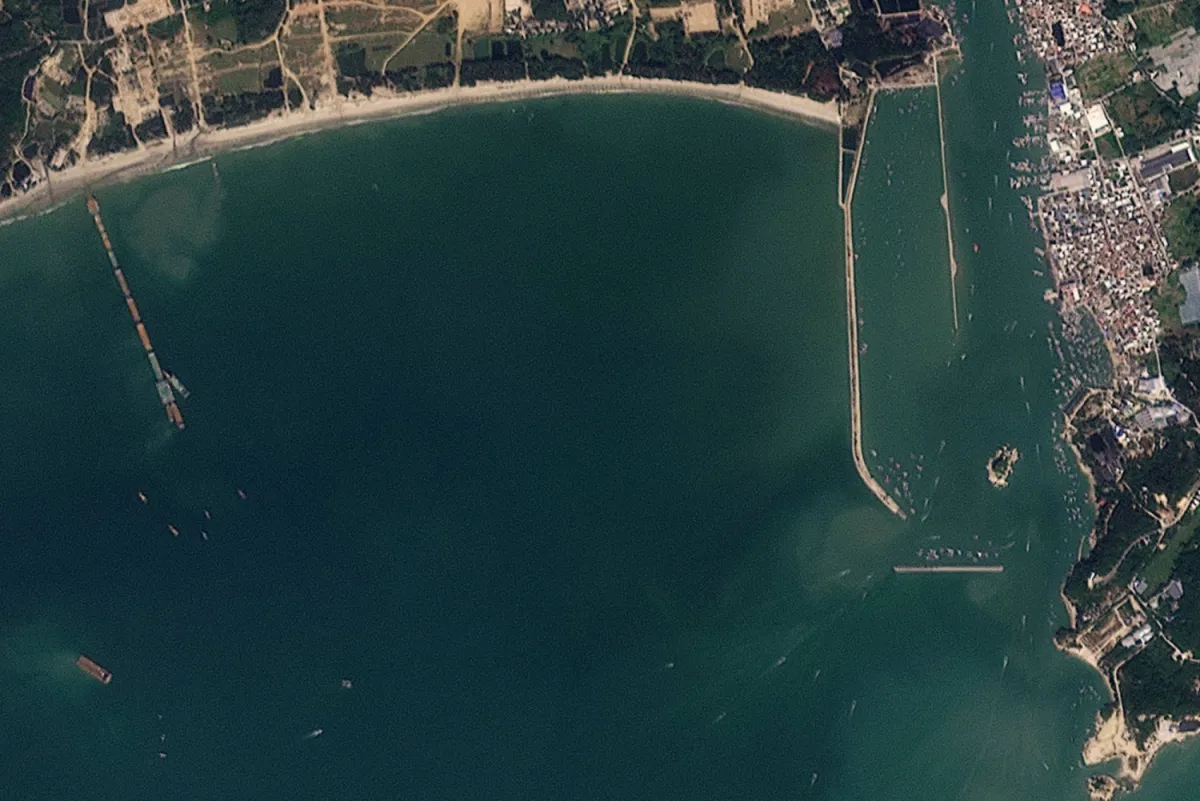
BEIJING – The Chinese military, the People's Liberation Army (PLA), has reportedly tested new troop landing tactics in coastal areas. This maneuver has raised serious concerns about a potential escalation of tensions in the Taiwan Strait, especially given the innovative methods employed by the PLA in 2026.
A research report, corroborated by satellite images, revealed surprising details of the drills. The new tactic involves the use of civilian vessels integrated to form makeshift floating bridges, facilitating the landing of troops ashore.
This innovation indicates China's efforts to accelerate and disguise amphibious landing operations. Global defense analysts view this method as part of a hybrid warfare strategy, where civilian assets can be rapidly mobilized for military purposes.
The use of civilian vessels raises complex ethical and international legal implications. The Hague Conventions regulate the distinction between combatants and non-combatants, as well as the use of civilian assets in armed conflict, but this tactic significantly blurs those lines.
The history of tensions between China and Taiwan spans decades. Beijing claims Taiwan as its territory and does not rule out the use of force to integrate it, while Taipei insists on its democratic sovereignty.
Military exercises of this nature, though not the first, mark an increase in China's capacity and creativity in military power projection. This places greater diplomatic and military pressure on Taiwan and its allies, including the United States under President Donald Trump's leadership.
Geopolitical observers see this maneuver as a clear message from China. The message is aimed not only at Taiwan but also at the international community, that Beijing is prepared to take extraordinary measures to achieve its territorial ambitions.
The implications of this tactic could alter the dynamics of a potential conflict. By reducing reliance on specialized military landing craft, China may hope to achieve a higher element of surprise and speed in large-scale amphibious operations.
However, this tactic also carries inherent risks, such as the vulnerability of civilian vessels to attack and the potential for civilian casualties who may be involved, albeit not directly as combatants.
Further reports are needed to understand the full scale of this capability developed by China. However, the signals sent are already strong enough to spark in-depth discussions among global policymakers and strategists.
Editorial Insight: The Chinese military's testing of new landing tactics through the use of civilian vessels is a worrying development. This step is not merely a routine exercise; it is a clear indication of a shift in military doctrine and a more aggressive power projection capability. Its long-term implications could be substantial, potentially altering the balance of power in the Asia Pacific and demanding a more coordinated strategic response from nations concerned with regional stability and the international order. This is a crucial episode in the geopolitical dynamics of 2026 that warrants serious attention.