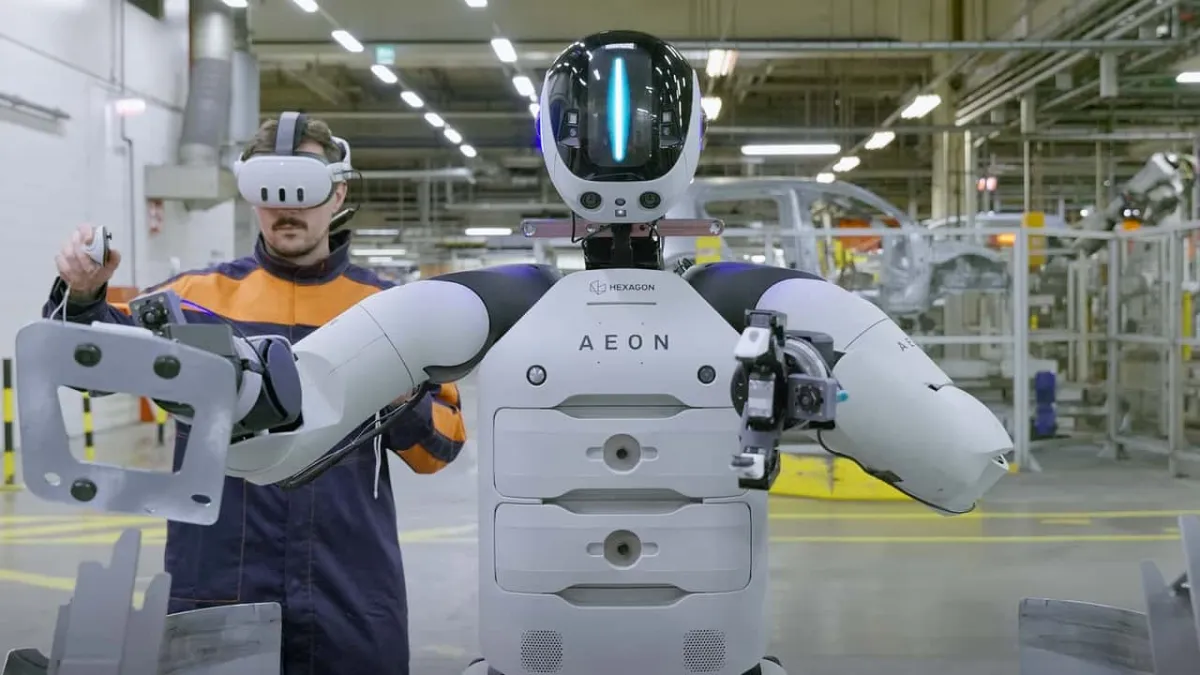
GHENT – Swedish automotive giant, Volvo, is progressively adopting advanced robotics technology by integrating Hexagon's AEON series humanoid robots into its production lines. This transformative initiative is centered at Volvo's plant in Ghent, Belgium, serving as a preliminary step before a wider pilot project implementation in the first half of 2027. This endeavor marks the beginning of a new era of human-machine collaboration on the factory floor.
The introduction of these robots aims to optimize manufacturing processes, enhance efficiency, and maintain precision in vehicle assembly. Currently, the AEON robots are undergoing an intensive learning phase, specifically in the task of fixture placement for production components. The adaptive capabilities of these robots are key to the success of this ambitious project.
Hexagon, a global technology company renowned for its metrology and industrial automation solutions, plays a vital role as the provider of the AEON humanoid robots. The anthropomorphic design of these robots allows them to operate within a work environment designed for humans, unlocking the potential for seamless collaboration without the need for extensive factory restructuring.
Engineers and technicians at the Ghent plant are working closely with Hexagon representatives to ensure optimal calibration and system integration. This learning phase is crucial to guarantee that the robots can perform their tasks with high accuracy and interact safely with human workers.
Volvo's strategic move transcends mere technological addition; it represents the company's long-term vision for the future of automotive manufacturing. With the increasing complexity of vehicle technology, including electric vehicles (EVs), the demand for production precision and efficiency becomes ever more pressing.
The integration of AEON humanoid robots can free human workers from repetitive or hazardous tasks, allowing them to focus on jobs requiring higher cognitive skills or decision-making. This holds the potential to reshape the employment landscape in the manufacturing sector.
The pilot scheduled for 2027 will be a decisive factor in the success of large-scale humanoid robot adoption across Volvo's production facilities. Results from the Ghent pilot project will serve as a crucial benchmark for expanding this technology to other Volvo plants worldwide.
The transformation of the automotive industry through automation has become a global trend. Various vehicle manufacturers are competing to implement advanced solutions to maintain competitiveness. Similar breakthroughs are also seen in other sectors, such as the development of rare-earth-free batteries by Suzuki or the adaptive cockpit revolution by Porsche, set to enliven the market in 2026. Suzuki's breakthrough and Porsche's cockpit revolution exemplify the dynamics of innovation in this industry.
The use of humanoid robots signifies not merely a replacement of labor, but an evolution of production methods. AEON robots are designed to adapt to dynamic environments, a significant advantage over conventional industrial robots which are often more static and isolated.
Implementing such robotic systems also presents challenges, particularly concerning the need for reskilling human labor and adapting safety regulations. However, the long-term potential benefits in terms of productivity and product quality are considered far greater.
Volvo's initiative in Ghent reaffirms the company's position as a pioneer in integrating cutting-edge technology to shape a more efficient, intelligent, and sustainable manufacturing future. The automotive world eagerly awaits the results of the 2027 pilot project.
Editorial Insight: Volvo's integration of humanoid robots is more than a technological innovation; it is a strategic statement about how the manufacturing industry will evolve. It marks a paradigm shift from heavy automation towards intelligent human-machine collaboration. The success of the Ghent pilot project will be a crucial indicator for the future of the global labor market and industrial production standards. The potential for increased efficiency and precision is immense, but attention to workforce adaptation and the ethics of technology use must remain a top priority.