 Debby Wijaya
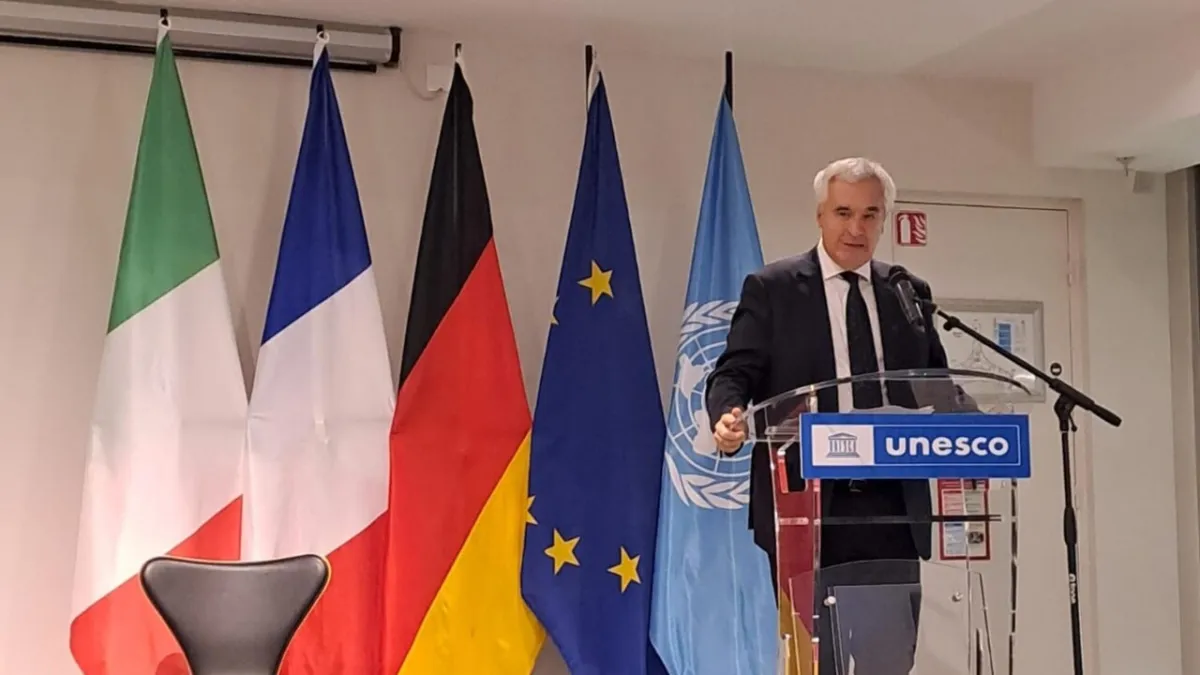
PARIS – Three leading global news agencies, Italy's ANSA, France's Agence France-Presse (AFP), and Germany's Deutsche Presse-Agentur (DPA), recently presented their ambitious project, the Democracy News Alliance, to the United Nations Educational, Scientific and Cultural Organization (UNESCO) at its headquarters in Paris. This collaborative initiative aims to build an ecosystem of major news agencies to ensure the dissemination of accurate and credible information, a crucial step amid the increasingly complex global information landscape in 2026.
The project was conceived in response to the massive challenges of disinformation and fake news, which are increasingly eroding public trust in the media. Through the Democracy News Alliance, these three agencies are committed to strengthening high-quality journalism as a bulwark for democracy and public enlightenment. They believe that the collective strength of news agencies can counterbalance false narratives that often spread rapidly.
Representatives from ANSA, AFP, and DPA outlined their vision before UNESCO delegates, highlighting the urgency of cross-border cooperation in verifying facts and presenting unbiased news. They emphasized that in this digital age, where information spreads at lightning speed, the role of news agencies in filtering truth has become even more vital.
UNESCO Director-General, Audrey Azoulay, welcomed the initiative, expressing her appreciation for the agencies' efforts. According to Azoulay, the protection of information integrity is the foundation of a healthy and democratic society. UNESCO consistently supports all efforts aimed at strengthening press freedom and combating the spread of falsehoods, especially amidst increasingly sharp global polarization, she stated.
The background to the birth of this alliance is inseparable from the infodemic phenomenon, which has become a serious threat. While artificial intelligence (AI) offers advancements, it also raises concerns about the potential for increasingly sophisticated information manipulation. This makes the role of verified professional journalism even more indispensable.
The leaders of ANSA, AFP, and DPA agreed that the ecosystem of large agencies they envision is not just about sharing news, but also about sharing ethical standards, best practices, and verification technologies. This forms the foundation for building long-term trust with a global audience.
The Democracy News Alliance initiative is expected to serve as a model for other international media collaborations. By combining forces, news agencies can create a stronger network to track, identify, and counter sources of disinformation, including those driven by state and non-state actors.
Discussions at UNESCO also covered the mechanisms for project implementation, including the potential development of joint technology platforms for fact-checking and news distribution. They considered how technology, when used correctly, can be a powerful tool to empower journalism.
This alliance emerges at a critical moment, given that many countries are facing elections or periods of political transition vulnerable to information interference. Therefore, the provision of objective and accurate news from trusted sources has become increasingly urgent to maintain social and political stability.
Through the Democracy News Alliance, ANSA, AFP, and DPA demonstrate their concrete commitment to the future of responsible journalism. They affirm that in the era of information challenges in 2026, news integrity is no longer merely an idealism, but an absolute necessity.
Editorial Insight:
This strategic move by ANSA, AFP, and DPA affirms that the future of journalism depends on cross-border collaboration and the reaffirmation of media's fundamental role in presenting the truth. This alliance has the potential to be at the forefront of the increasingly complex battle against disinformation, offering structural solutions for a healthier news ecosystem. The challenge lies in ensuring widespread reach and implementation, as well as securing sustained support from various stakeholders, including governments and technology platforms.