 Dorry Archiles
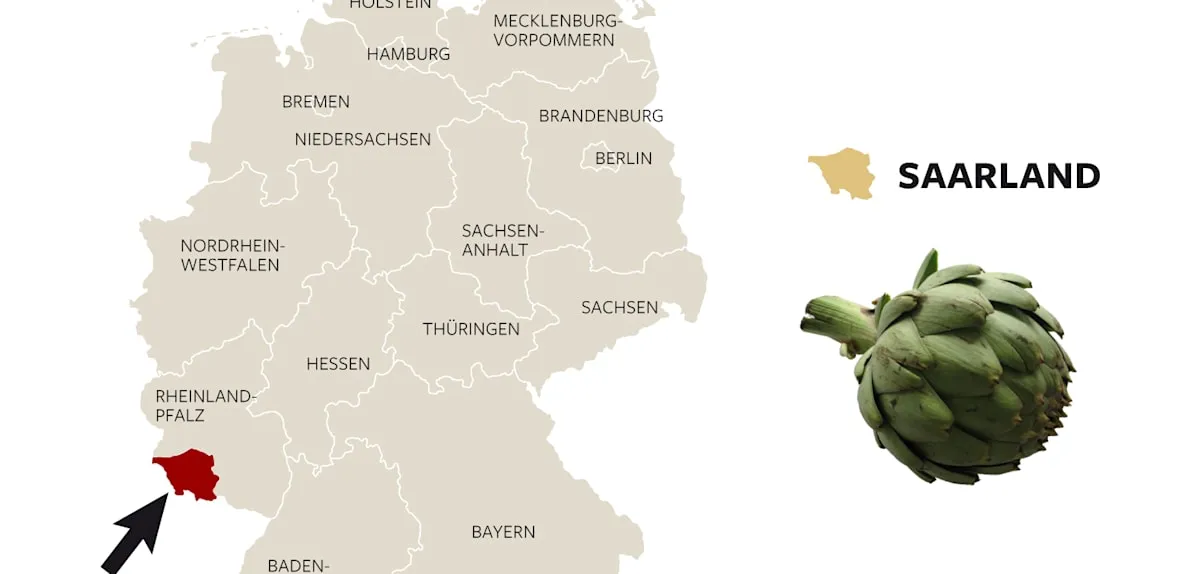
Southwest Germany — German geographers recently announced a surprising discovery in the country's southwest: an administratively uncharted area, precisely 2,569.69 square kilometers in size, equivalent to the state of Saarland. This monumental finding has sparked serious debate about modern mapping methodologies and the potential existence of other 'hidden' areas in Europe, which was previously considered fully documented.
A joint research team from several leading German universities, under the coordination of the National Institute of Geography, reported their comprehensive investigation results in early 2026. This discovery is not merely the identification of vacant land, but an official recognition of a geographical entity that, administratively, had not previously been integrated into the system of territorial records.
This anomalous region is located between the borders of three states, but it has not yet been specifically determined whether it belongs to one of the existing jurisdictions or is an independent entity requiring new classification. The use of the latest generation satellite mapping technology, combined with extensive ground survey data over the past five years, revealed the topographical and ecological details of the area with precision.
Professor Klaus Richter, head of the research team, expressed his astonishment at the finding. “For decades, we believed that every inch of Europe had been precisely recorded. This discovery reshapes that paradigm,” he stated at a press conference in Berlin. “This is not about land that suddenly appeared, but an area that escaped detailed classification and recording in both political and geographical maps.”
The implications of this discovery are far-reaching, encompassing aspects of spatial planning, environmental conservation, and potential administrative claims in the future. The German federal government and the relevant state governments have formed an ad-hoc team to follow up on the legal and administrative status of this new region, a process expected to take years to resolve.
Dr. Lena Müller, a geospatial expert from Heidelberg University, added that this discovery could open a new chapter in geography and cartography. “We may need to reconsider the definition of 'known' or 'mapped territory.' Even on a densely populated continent like Europe, there is still room for significant scientific surprises,” she commented.
Initial data indicates that this region possesses rich biodiversity, with relatively untouched forest and river ecosystems and minimal human intervention. The potential for establishing it as a conservation area is a major topic of discussion among environmental experts and government officials. Such discoveries can enrich global conservation efforts, aligning with initiatives such as transforming empty land into an oasis for the soul and environment.
The area's size, equivalent to Saarland—one of Germany's smallest yet densely populated states—provides a clear picture of the scale of this discovery. Saarland is known for its industrial history, coal mining, and unique cultural landscape; comparing this new region to a known entity helps the public understand its geographical and political significance.
Next steps involve conducting more in-depth field expeditions to identify specific flora and fauna, as well as analyzing the geological and hydrological characteristics of the region. Local and federal governments will also engage in intensive discussions about its official naming and how the area will be managed moving forward, including the potential for infrastructure development if deemed necessary.
This discovery serves as a reminder that amidst technological advancements and information globalization, Earth still holds mysteries waiting to be unveiled. The story of this 'newly found' region, the size of Saarland, is certainly destined to be a topic of intense research and discussion within the global scientific community for many years to come, changing our perspective on the world maps we thought we knew.
Geographers hope this finding not only prompts further exploration in Germany but also inspires a systematic review or remapping of other regions that may still hold similar surprises, even on continents considered thoroughly mapped. This underscores that scientific exploration is an unending process.