 Chandra Wijayanto
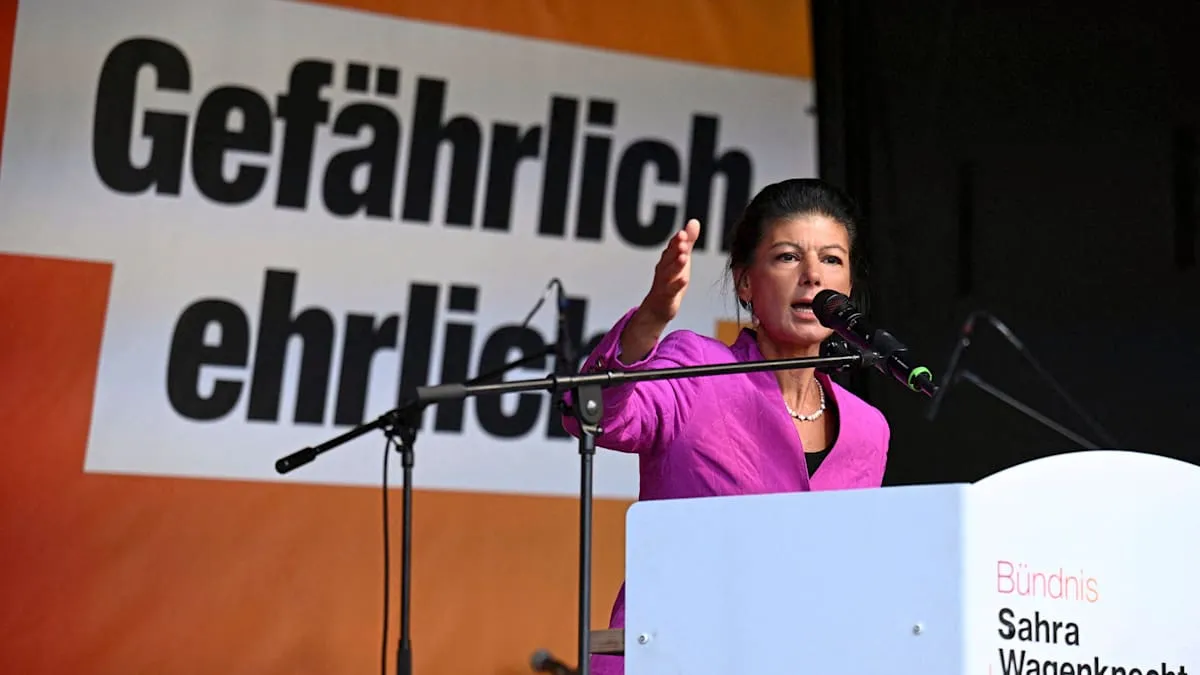
SCHWERIN – The Christian Democratic Union (CDU) faces an existential threat in the local German political arena, following a surprising call from influential politician Sahra Wagenknecht for voters to cast tactical votes for the Sahra Wagenknecht Alliance (BSW) in the Mecklenburg-Vorpommern Landtag election on September 20, 2026. Electoral analyses indicate that a worst-case scenario could mathematically see the CDU expelled from the state parliament, triggering alarms across the German political spectrum and underscoring a dynamic shift in the political landscape.
Wagenknecht's appeal, from a charismatic figure known for her sharp criticism of established parties, comes at a time when public sentiment in Germany is turbulent. The newly founded BSW has garnered significant attention with a platform focused on social justice and rejection of foreign military intervention, positioning itself as an alternative for disillusioned voters.
Mecklenburg-Vorpommern, a state in northeastern Germany, has a complex political history. The region often serves as a battleground for fierce inter-party contests, with political forces shifting over time. For the CDU, losing its foothold in this state's Landtag is not just a local defeat, but a symbol of potential erosion of national support.
According to electoral calculations, if the BSW successfully mobilizes tactical votes, the CDU's vote share could fall below the minimal 5 percent threshold required to gain seats in parliament. The consequences of this scenario would be a severe blow to a party that has historically been one of the main pillars of German democracy.
Political observers highlight that the BSW's strategy directly targets the voter base of the CDU and other major parties, capitalizing on dissatisfaction with current government policies. It also demonstrates the increasing fragmentation of German politics recently, with more smaller parties able to challenge traditional dominance.
Concerns among CDU leaders are escalating. The party's efforts to shield itself from extremist threats, as seen in confidential documents concerning CDU's efforts to secure itself from the AfD, are now challenged by a different political spectrum, namely the left-populist BSW.
Should the CDU fail to retain its seats, it would trigger intense internal debates regarding the party's direction and future strategy, similar to discussions after the Niedersachsen election which also urged drastic political changes in Berlin. This potential defeat could ripple and affect political dynamics at the federal level.
The election in Mecklenburg-Vorpommern on September 20, 2026, therefore, becomes more than just a local contest. It is a crucial barometer for the resilience of Germany's traditional parties and an indicator of rising new political forces, such as the BSW.
Other parties, including the Social Democrats (SPD), the Greens, and the AfD, will also closely monitor the election results. Any shift in votes will impact the composition of parliament and potential coalition formations, which are often complex and tense processes.
Editorial Insight:
The situation in Mecklenburg-Vorpommern illustrates the vulnerability of established parties amidst an ever-changing political landscape. Calls for tactical voting by figures like Sahra Wagenknecht are not merely campaign strategies, but a reflection of public demand for more diverse political options. For the CDU, this is a fundamental test of their adaptability and relevance in an increasingly competitive era, with potential implications extending far beyond the state's borders.