 Angela Stefani
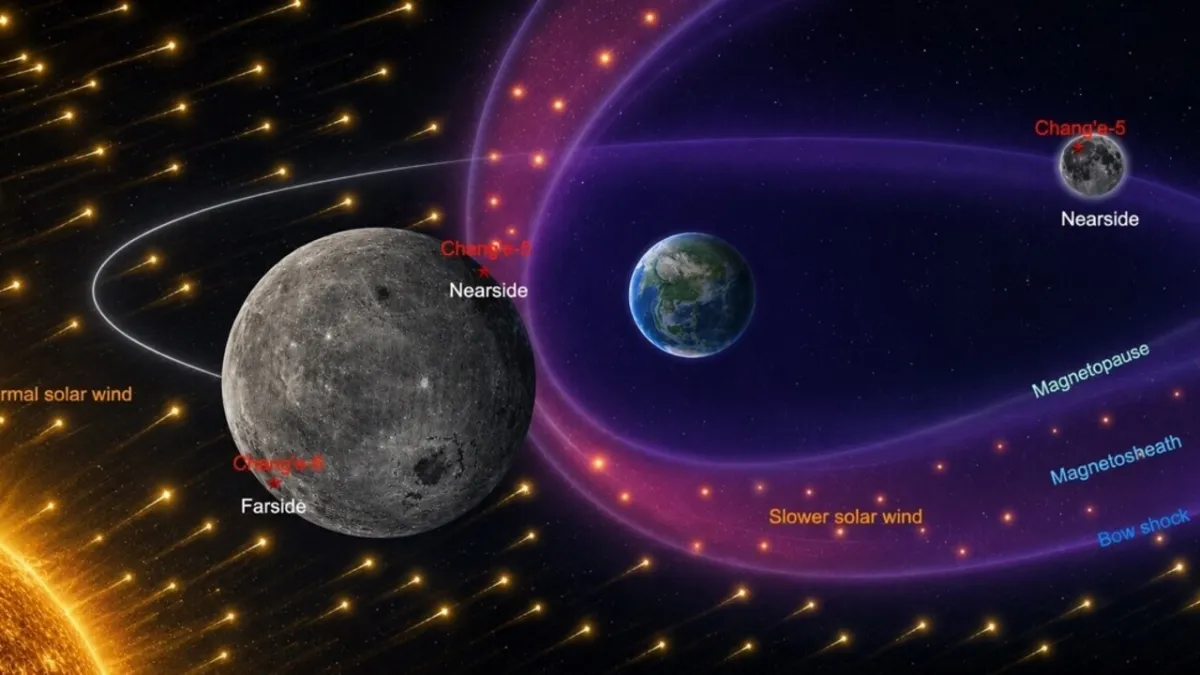
China — A revolutionary analysis of regolith samples collected by the Chang'e-6 mission reveals a surprising fact: Earth significantly dampens the speed of solar wind reaching the Moon's Earth-facing side. This fundamental discovery, announced by scientists in 2026 after in-depth studies, reshapes our understanding of the complex interactions between our planet, its natural satellite, and the Sun's dynamics. It provides new insights into the Moon's geological history and the dynamic space environment.
The Chang'e-6 mission, a pioneering endeavor by the China National Space Administration (CNSA), successfully landed on the Moon's far side in June 2024 and returned to Earth with pristine lunar rock and dust samples. This bold exploration opened a unique window to study the conditions of the lunar far side, shielded from direct Earth interference. The contrast between far-side and near-side samples proved key to this discovery.
Solar wind consists of a continuous stream of charged particles released from the Sun's corona. This stream of particles travels at high velocities and can interact strongly with celestial bodies. Scientists have long known that Earth's magnetic field, or magnetosphere, serves as a vital protective shield for our planet, deflecting most of the solar wind.
However, Earth's damping effect on the Moon, particularly on the Earth-facing side, turns out to be more substantial than previously thought. Data from far-side lunar regolith samples indicate a significantly more intense solar wind exposure compared to what is believed to exist on the Moon's near side. This disparity serves as strong evidence that Earth acts as a partial barrier.
Professor Li Wei of the National Astronomical Observatories of China stated in a press conference, "The samples from the lunar far side are invaluable time capsules. They record a different solar wind exposure compared to what we find on the Moon's near side. This indicates a clear protective effect of Earth on the Moon, even beyond the scope of our traditional magnetosphere."
This discovery challenges previous models regarding solar wind exposure on the Moon. Researchers now hypothesize that Earth not only deflects solar wind within its own orbit but also creates a significant "calm zone" in the surrounding space, which reduces the bombardment of charged particles on the Moon's near side.
The implications of this finding are vast. A better understanding of how solar wind interacts with the Moon can aid in designing future human settlements on the Moon. Even a small amount of natural protection from Earth could be a critical factor in site selection and infrastructure design.
Furthermore, this research also provides clues about the Moon's early evolution. By knowing the level of solar wind exposure at different periods, scientists can reconstruct the environmental conditions of the Moon and Earth in the past. This is a crucial piece of the puzzle in understanding the history of our solar system.
The use of advanced technology to analyze the isotopic composition and trace noble gases in the Chang'e-6 regolith was a critical factor. These methods allowed researchers to precisely measure the exposure to charged particles from the Sun over billions of years. The results confirm significant differences between the two sides of the Moon.
Collaborative studies involving scientists from various countries are expected to deepen this research. The Chang'e-6 findings are not merely a Chinese achievement but a global contribution to space science. Moving forward, missions like Artemis, aimed at returning humans to the Moon, will also benefit from these insights.
This discovery affirms that the Moon, though seemingly static, is a silent witness to the dynamic interactions between the Sun and Earth. The analysis of regolith from the lunar far side offers profound new perspectives, opening a new chapter in our understanding of the solar system and the challenges of human exploration beyond Earth's planetary boundaries.