 Edward DP Situmorang
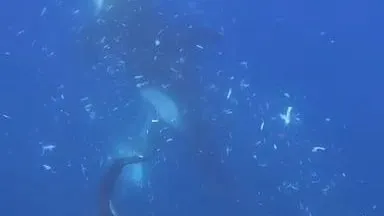
PACIFIC OCEAN — A video recording recently released in early 2026 has electrified the scientific community, showcasing for the first time orcas (killer whales) employing a previously unobserved hunting tactic to dismember a giant sunfish (Mola mola) in offshore waters. This discovery, captured by researchers, provides new insights into the intelligence and complex behavior of these apex ocean predators.
The dramatic video depicts a group of orcas meticulously coordinating their attack on a Mola mola, also known as the sunfish, renowned as one of the heaviest bony fish in the world. They not only killed their prey but appeared to “play” with its carcass, a behavior indicative of extraordinary cognitive and social sophistication.
Researchers from various marine institutions in 2026 stated that this observation is significant because the Mola mola has a unique, laterally flattened, and very thick body, making it difficult to catch and consume. It can weigh over two tons, demanding highly specific and coordinated hunting strategies.
In the footage, the orcas are seen swimming around the Mola mola, pushing it to the surface, and then using their tails and bodies to tear its flesh. This process appeared systematic, suggesting planning and division of roles among the group members.
Dr. Arto Nurmi, a leading marine biologist from a prominent National University who followed the video’s release, commented, “This is not merely hunting for survival. It is a demonstration of extraordinary environmental mastery and adaptive intelligence. The ‘play’ behavior with prey often indicates that these orca pods are in peak condition, with well-internalized hunting expertise.”
This discovery adds to the long list of known orca hunting techniques, such as the wave-wash strategy to knock seals off ice, or the deadly maneuvers when pursuing other whales. However, dismembering a Mola mola in this manner is novel to science.
The Mola mola itself is a fascinating marine organism. Its large and distinctive body often makes it an object of curiosity, yet it is rarely seen falling victim to apex predators like orcas. Mola mola are often considered too large and unwieldy for most predators to manipulate.
Previous observations have also demonstrated the sophistication of orcas in dealing with large prey. For instance, it has been revealed that Orcas Attack Giant Mola mola with Brutal Tactics in the Gulf of California, showing organized attack patterns, but clear visual records like this remain extremely rare.
Experts suggest that this behavior is not just about food, but also about teaching and reinforcing social skills within orca pods. Young orcas may learn from their elders how to handle large and challenging prey.
This video is expected to spur more research into the diet and hunting behavior of orcas, particularly in relation to their interactions with other marine megafauna. A deeper understanding of these apex predators is crucial for the conservation of global marine ecosystems.
The research team plans to continue analyzing this footage in greater detail, hoping to uncover further nuances about communication and coordination among orcas during these complex hunting activities. Every small detail could be a key to unlocking the mysteries of marine intelligence.