 Demian Sahputra
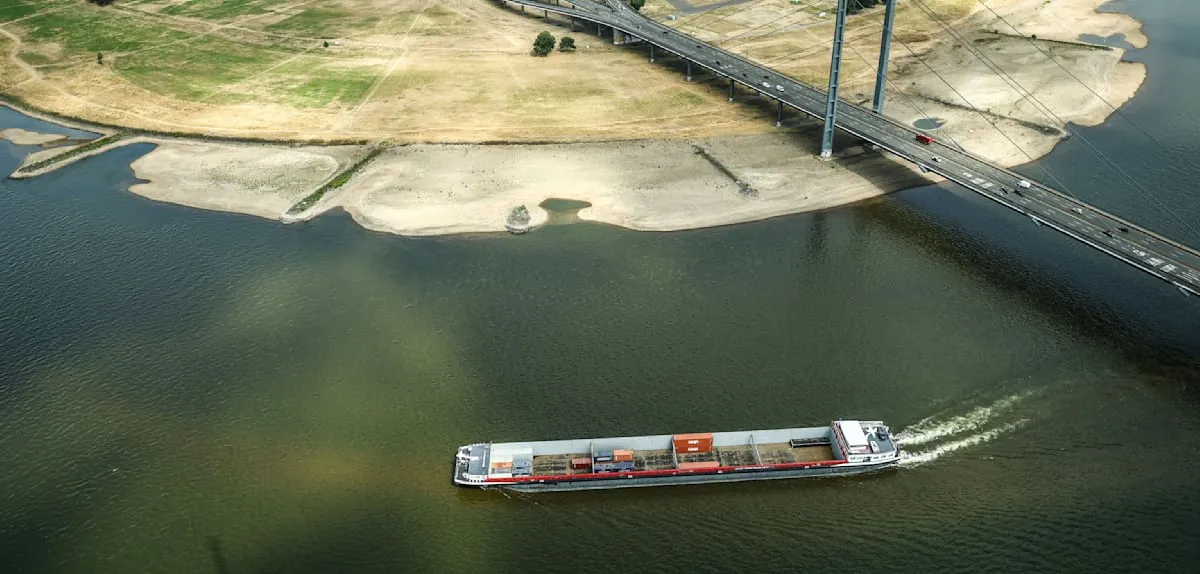
Hamburg, Germany – The historically low water levels of the Rhine River throughout 2026 have led to increased transportation costs and put significant pressure on industrial sectors across Europe. However, forwarders in Hamburg are seizing this condition as a strategic moment for shippers to re-evaluate their port choices and logistics routes, potentially transforming the continent's supply chain landscape.
The phenomenon of the receding Rhine, a vital waterway connecting Germany's industrial heartlands and neighboring countries to the North Sea ports, has become a recurring challenge in recent years. Inadequate water depths force cargo ships to reduce their loads or seek more expensive alternatives, resulting in delivery delays and substantial increases in operational costs for manufacturing companies and raw material producers.
Logistics business players in Hamburg are proactively highlighting their port's geographical advantages and infrastructure capacity. They argue that the Rhine's current state is a clear signal for supply chain managers to consider more stable maritime and land routes, traditionally served by the Port of Hamburg.
"We understand the pressure faced by industries due to navigation limitations on the Rhine," stated Klaus-Dieter Borchardt, Chairman of the Hamburg Forwarding and Logistics Association, in an online interview in mid-2026. "However, this is also a moment for introspection. Hamburg offers superior rail and road connectivity, coupled with deep-water port capacity, making it a more resilient choice against climate fluctuations."
The decline in water depth on the Rhine has reached historical lows at several crucial points, such as Kaub, which serves as a key benchmark. This not only affects the shipment of bulk commodities like coal and iron ore but also chemical products and finished goods, threatening production schedules and stock availability at various factories.
Despite significant investments in dredging and other mitigation efforts on the Rhine, long-term solutions remain under debate. The increasingly extreme global climate conditions in 2026 indicate that similar problems are likely to recur, strengthening the argument for logistics route diversification.
Therefore, Hamburg's offer to become an alternative hub is increasingly relevant. With its dense rail network integrated throughout Central and Eastern Europe, the port provides an efficient and reliable transportation route, reducing dependence on river transport vulnerable to weather changes.
Large corporations that have relied on the Rhine for cost efficiency now face a difficult choice: bear continuously increasing additional costs or invest in restructuring their supply chains. This decision will have long-term implications for the competitiveness of European products in the global market.
Global economic analysts from institutions such as Deutsche Bank and Commerzbank estimate that if the low water trend on the Rhine continues, the Port of Hamburg's market share in intra-European logistics will significantly increase over the next five years. This will strengthen Hamburg's position as one of Europe's main gateways to the world.
The German government and the European Union are also aware of the urgency of this situation. They are exploring comprehensive climate adaptation strategies for transport infrastructure, including a re-evaluation of investments in inland waterways and the development of alternative transport modes that are more resilient to climate change.
Thus, the Rhine crisis is not merely an environmental or logistical problem but also a catalyst for a fundamental transformation in how Europe views and manages its distribution networks. Hamburg, with its strategic position, is ready to play a central role in this revolution.
Logistics experts emphasize the importance of collaboration among governments, port operators, and freight forwarders to ensure a smooth transition. This synergy is crucial for building a more resilient and adaptive European logistics system to face future climate challenges.
International shipping companies like Maersk and Hapag-Lloyd have already begun optimizing their routes through Hamburg, rerouting some cargo volumes previously traversing the Rhine. This step demonstrates the industry's recognition of the urgency for diversification and the solutions offered by Hamburg.
The success of this strategy will not only benefit Hamburg economically but also provide valuable lessons for other regions worldwide facing the impact of climate change on their vital infrastructure. Proactive adaptation is key to the continuity of global supply chains.