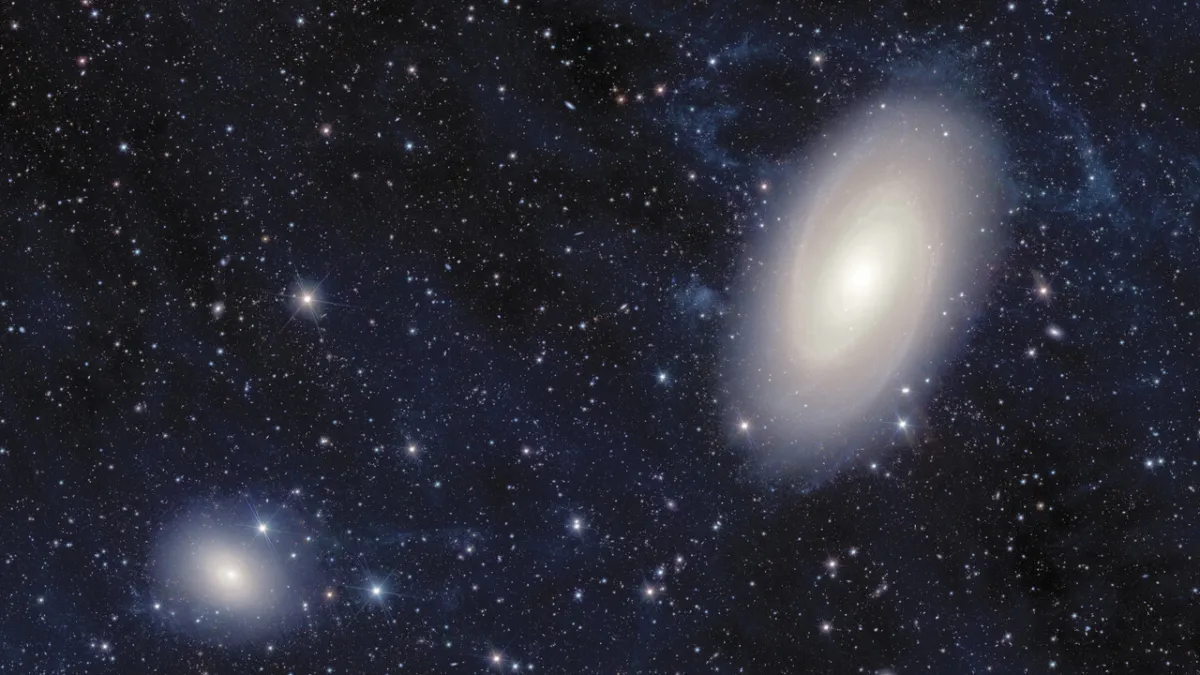
PARIS – A monumental breakthrough in astronomy was achieved in 2026. The European space telescope Euclid, operated by the European Space Agency (ESA), released the most comprehensive map of the cosmos to date, detailing approximately 900 million galaxies. This discovery is not merely a spectacular imaging feat, but a new foundation for understanding the mysteries of dark matter and dark energy that dominate the universe.
This extraordinary map, announced from Euclid's mission control center, provides an unprecedented view of the universe's large-scale structure. The collected data is expected to revolutionize our understanding of galaxy evolution and matter distribution in space, paving the way for deeper cosmological research.
The Euclid mission itself was launched with the primary goal of mapping the geometry of the dark universe and measuring its expansion history. With highly sensitive instruments, the telescope is capable of capturing light from incredibly distant galaxies, allowing scientists to look back in time at the universe's past.
The discovery of 900 million galaxies significantly surpasses previous surveys, providing an unparalleled dataset for analysis. Researchers now possess a powerful tool to test standard cosmological theories and search for clues about the fundamental nature of dark matter and dark energy.
Professor Anna Meier, a leading cosmologist from Cambridge University, stated, 'This is an incredibly important moment for astrophysics. The scale of the data presented by Euclid allows us to map the distribution of dark matter with unprecedented precision. We are approaching a new era in understanding the structure of the universe.'
The technology behind Euclid, including its visible-light camera and near-infrared spectrometer, is designed to measure the shapes of galaxies and their distances from Earth with high accuracy. This information is crucial for analyzing the effects of weak gravitational lensing, a phenomenon caused by dark matter.
The volume of data generated from these observations is immense, demanding advanced computational capacities for processing and analysis. The Euclid Consortium, involving hundreds of scientists from various countries, has worked tirelessly to transform raw data into a cohesive map of the cosmos.
The implications of this map extend beyond theoretical understanding. Information regarding the distribution of galaxies and dark matter can help identify regions in the universe with high or low density, which in turn can explain how galaxies formed and evolved within the cosmic web.
However, scientists acknowledge that many challenges remain. Interpreting such a vast amount of data requires increasingly accurate theoretical models and innovative analytical techniques. Fundamental questions about the nature of dark energy, responsible for the accelerated expansion of the universe, remain a primary focus of research.
The Euclid project represents one of the largest collaborative efforts in space science, involving contributions from various institutions and experts across Europe and beyond. This demonstrates how international collaboration is key to achieving major paradigm-shifting discoveries.
With this new cosmic map, the scientific community hopes to reach a better consensus on the most accurate model of the universe, while also identifying new areas for future exploration and observation.
Editorial Insight: The release of the 900 million galaxy cosmic map by the Euclid Telescope marks a significant turning point in cosmology. This data not only enriches our knowledge base about the universe but also has the potential to trigger a revolution in the understanding of dark matter and dark energy. The success of this mission underscores the importance of long-term investment in space research and cross-border scientific collaboration to answer fundamental questions about our existence. This is a crucial step forward that will shape the direction of universe studies for decades to come.