 Debby Wijaya
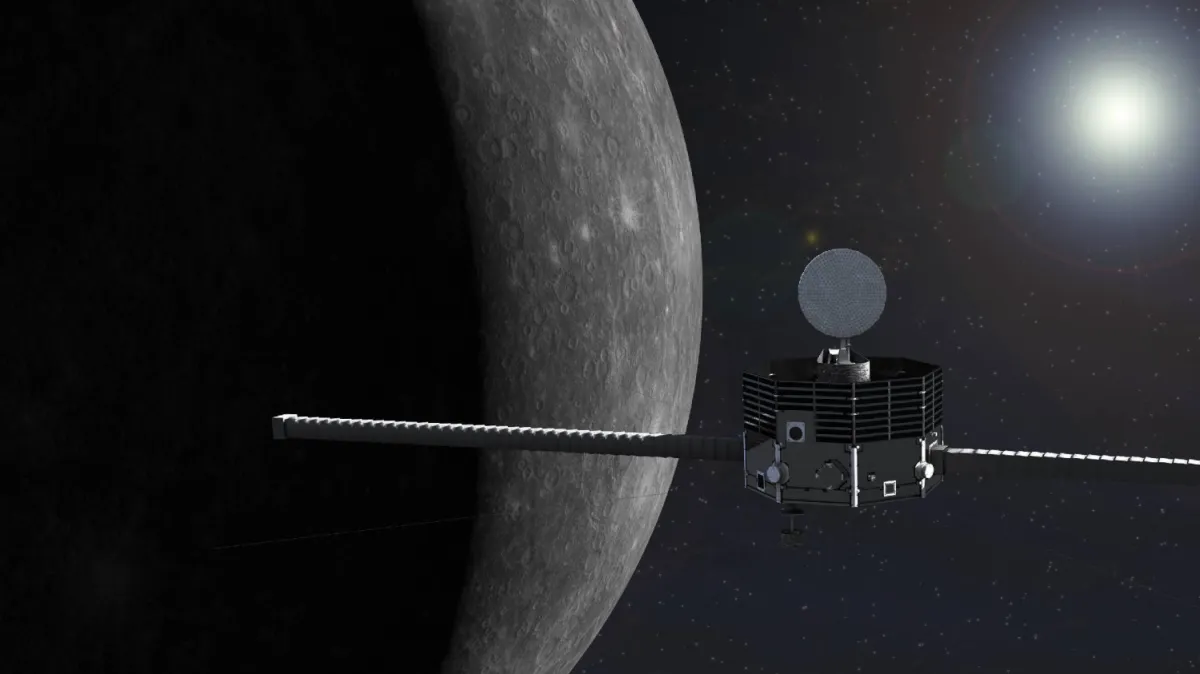
JAKARTA – The Japan Aerospace Exploration Agency (JAXA) and the European Space Agency (ESA) have written a new chapter in space exploration. Together, they successfully placed the BepiColombo spacecraft into Mercury's orbit, opening a crucial phase in the study of the planet closest to the sun. This monumental joint mission, in 2026, aims to unravel the mysteries of Mercury's magnetic field and atmosphere, providing deep insights into the formation of our solar system.
The successful orbital insertion marks the culmination of a long and complex journey spanning several years. BepiColombo, launched in October 2018, traversed an intricate path, performing a series of gravity assists at Earth, Venus, and Mercury itself, before finally reaching its ultimate destination.
Scientists from both space agencies expressed euphoria over this achievement. 'This is a truly proud moment for the entire team at JAXA and ESA,' said a BepiColombo mission spokesperson from the European Space Operations Centre (ESOC) in Darmstadt, Germany. 'The data we will collect from this orbit will transform our understanding of Mercury.'
BepiColombo's primary objective is to conduct a comprehensive study of Mercury. This planet, extreme in every aspect, possesses an unusual magnetic field and a thin atmosphere called an exosphere. Understanding these characteristics is essential for uncovering Mercury's geological history and evolution.
The spacecraft itself consists of two separate orbiters: the Mercury Planetary Orbiter (MPO) built by ESA, and the Mercury Magnetospheric Orbiter (MMO) or 'Mio' developed by JAXA. The MPO will focus on mapping the planet's surface and analyzing its internal composition, while Mio will study the magnetosphere and its interactions with the solar wind.
The challenges in researching Mercury are considerable. Its proximity to the sun means the spacecraft must withstand radiation and extreme temperatures that can reach 450 degrees Celsius on the sunlit side and plummet drastically on the night side. Innovative technologies, including specialized ceramic heat shields and advanced cooling systems, are integrated into BepiColombo to endure these brutal conditions.
Previous missions such as NASA's Mariner 10 in the 1970s and MESSENGER in the early 2000s provided initial glimpses of Mercury. However, BepiColombo is designed to deliver data with significantly higher resolution and depth, filling substantial knowledge gaps.
The collected data is expected to help scientists understand why Mercury has such a high density, possesses a large iron core, and why its magnetic field is much weaker compared to Earth's. It may also offer clues about how rocky planets form and evolve in extreme environments.
The collaboration between JAXA and ESA represents the pinnacle of international scientific cooperation. This ambitious project demonstrates that by combining resources and expertise, the boundaries of space exploration can continually be pushed. It is a tangible example of how global partnerships can lead to extraordinary scientific breakthroughs.
Researchers now eagerly await the initial data to be transmitted by BepiColombo. Every detail, from gravitational variations to surface chemical composition, will be meticulously analyzed to build a more accurate model of Mercury.
This mission also serves as a foundation for future space exploration endeavors, paving the way for technological innovations required to explore even more challenging environments within our solar system and beyond.
Editorial Insight:
The success of the BepiColombo mission in 2026 is not merely a technical achievement but a significant leap in humanity's understanding of the cosmos. This in-depth study of Mercury has the potential to revise theories about planet formation and solar system evolution. Furthermore, the cross-continental collaboration between Japan and Europe underscores the importance of science diplomacy in addressing global challenges and pushing the boundaries of knowledge. The long-term impact of the data acquired by BepiColombo will resonate for decades to come, influencing the direction of astrophysics and planetary geology research.