 Chris Robert
JAKARTA – The global crypto investment community is now focusing its attention on Bitcoin following strong indications of a technical Death Cross pattern emerging on November 27, 2026. This signal, formed when the 50-day moving average price crosses below the 200-day moving average price, has historically often preceded periods of significant correction, raising investor concerns about potential market volatility in the near future.
The Death Cross is one of the most closely watched technical analysis indicators in financial markets. This pattern signals a shift in momentum from bullish to bearish, and its appearance is often interpreted as a sign of increased selling pressure and potential further price declines for the asset.
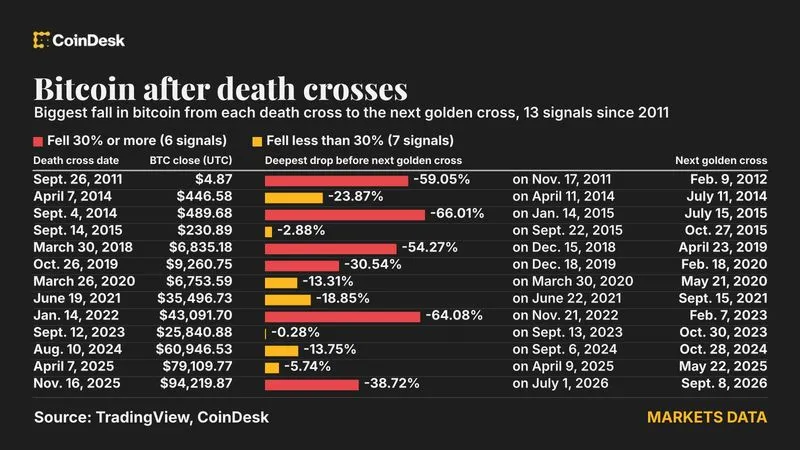
In the context of Bitcoin, the Death Cross is not a new phenomenon. Historical analysis shows that out of 13 previous Death Cross occurrences, most were followed by periods of consolidation or significant price declines. Although it does not always guarantee a sharp correction, this pattern serves as an important warning for market participants.
Historical data indicates that after a Death Cross formation, Bitcoin often experiences an average decline of between 10% to 50% in the following weeks or months. The worst declines occurred in years of extreme bear markets, resulting in substantial losses for unwary investors.
However, it is important to note that the crypto market is known for its high volatility and does not always strictly follow technical patterns. Some previous Death Crosses were occasionally followed by quick recoveries or false signals, especially if underlying market fundamentals remained strong. Nevertheless, this current signal arrives at a time when the global market is also facing economic uncertainty.
Analysts from various financial institutions advise investors to increase their vigilance. The Death Cross is an alarm, not a certainty of collapse, said an independent crypto market analyst who wished to remain anonymous. However, ignoring it is reckless, especially for those holding short-term positions.
Market sentiment is mixed. Some investors choose to reduce their risk exposure, anticipating potential turmoil. Meanwhile, other groups see this as a long-term buying opportunity, believing that any Bitcoin price drop is a discount before the next rally. Previously, Bitcoin had surged above $61,000 fueled by positive AI stock sentiment.
For comparison, similar formations in 2022 and early 2025 indeed preceded fairly long periods of decline, which were then followed by gradual recovery. However, each market cycle has its own unique dynamics, influenced by macroeconomic factors, regulations, and institutional adoption.
Concerns about the Death Cross are also compounded by reports of a Bitcoin capitulation signal in 2026, triggering fears of supply plummeting to an eleven-year low, indicating underlying fundamental pressures that may underpin this technical movement. The combination of these two signals could create more challenging market conditions.
Market observers predict that several factors could strengthen or weaken the impact of this Death Cross, including global central bank interest rate decisions, crypto regulatory developments in major countries like the United States and the European Union, and Bitcoin adoption by mainstream financial institutions.
Investors are advised not to rely solely on one technical indicator. A combination of fundamental analysis, market sentiment, and careful risk management is key to navigating periods of uncertainty like the present. Portfolio diversification and setting stop-losses are prudent strategies.
Editorial Insight: The emergence of Bitcoin's Death Cross signal in late 2026 is not merely a technical phenomenon, but a reflection of the complex dynamics of the crypto market continually interacting with the global economy. While history suggests a bearish pattern after this signal, market adaptation and the entry of institutional players might introduce different characteristics. Investors need to prioritize thorough research and a long-term perspective, avoiding panic decisions that often lead to losses.