 Robert Andrison
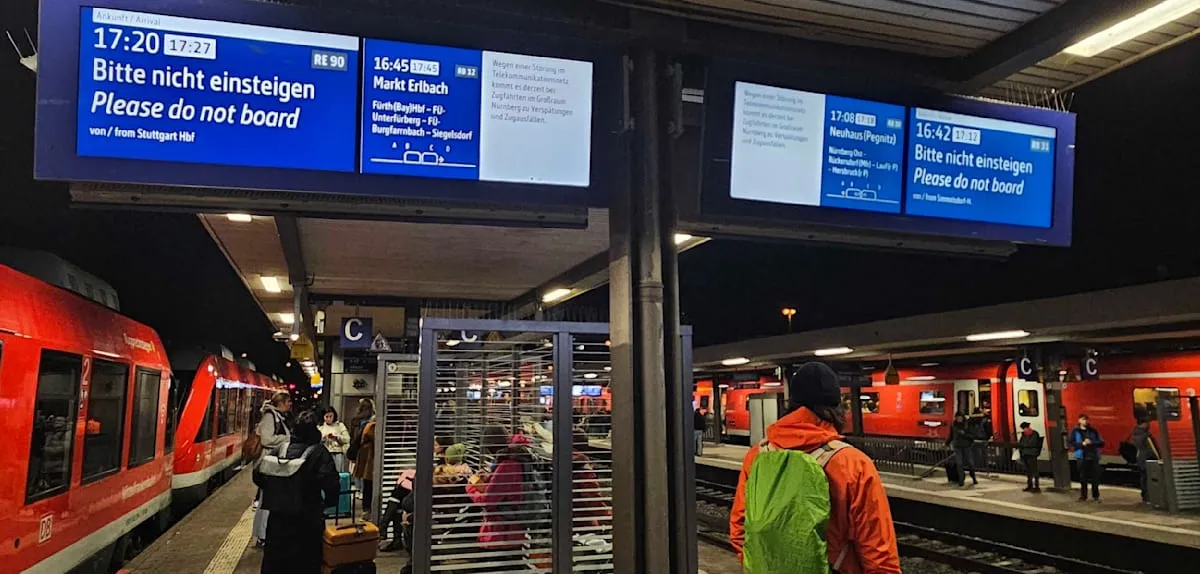
NUREMBERG – All train services to and from Nuremberg Main Station were completely paralyzed today, [Current Date], 2026, after a technical malfunction in the GSM-R railway radio system caused significant disruption. This incident, occurring locally at the heart of German transportation, led to the detention of all passenger trains, S-Bahns, and long-distance services, stranding thousands of passengers and raising concerns about broader economic and logistical impacts.
The primary cause of this paralysis, according to the national railway operator, is a local disruption to the GSM-R system, an essential wireless communication infrastructure for coordinating and ensuring the safety of modern railway operations. Without a functioning signal, traffic controllers cannot communicate with train drivers or monitor train movements, forcing a complete halt to prevent potential hazards.
The immediate consequence of this incident is massive chaos at one of Bavaria's busiest transportation hubs. Hundreds of scheduled journeys were canceled or indefinitely delayed, creating long queues and confusion among travelers, commuters, and tourists hoping to reach their destinations.
Nuremberg Main Station, typically a vital node connecting various major cities in Germany and Europe, is now filled with cancellation announcements and uncertainty. Passengers are forced to seek alternative transportation, ranging from limited replacement buses to ride-sharing, but the available capacity is far from sufficient to accommodate the affected passenger volume.
A spokesperson for Deutsche Bahn (DB) stated that technical teams were immediately deployed to identify and rectify the source of the malfunction. 'The safety of passengers and crew is our top priority. We understand the frustration experienced by passengers and are working hard to restore services as quickly as possible,' a DB representative said in an official statement. They also added that the repair process could take a considerable amount of time, given the complexity of the GSM-R system.
This disruption not only affects German domestic routes but also has ripple effects on cross-European connectivity. Nuremberg is an integral part of the European railway network, serving important routes to Austria, the Czech Republic, and other neighboring countries. These cancellations effectively isolate the region from much of the continent's train traffic.
The Bavarian regional government urged Deutsche Bahn to provide full transparency regarding the cause of the incident and the mitigation measures being taken. Officials also called for a comprehensive evaluation of the resilience of railway communication infrastructure to prevent similar occurrences in the future, especially given its crucial role in the regional economy.
Radio system malfunctions like GSM-R highlight the vulnerability of the digital infrastructure underpinning essential public services. High dependence on advanced technology means that even a small component failure can paralyze an entire system, with consequences extending far beyond mere financial losses.
As of this report, there is no definitive estimate for when train services at Nuremberg Main Station will be fully restored. Passengers are advised to continue monitoring the latest information from Deutsche Bahn and consider alternative transportation if possible, given the ongoing uncertainty surrounding the situation.
Editorial Insight: This incident in Nuremberg is more than just a regular train delay; it is an alarm bell for the reliability of the digital infrastructure that underpins modern life. Dependence on systems like GSM-R, designed for efficiency and safety, becomes a point of vulnerability when malfunctions occur. This event urges global transport authorities to not only invest in technological updates but also in robust backup systems and more responsive crisis protocols. Without proactive steps, similar paralysis could occur at any time, threatening economic stability and public mobility.